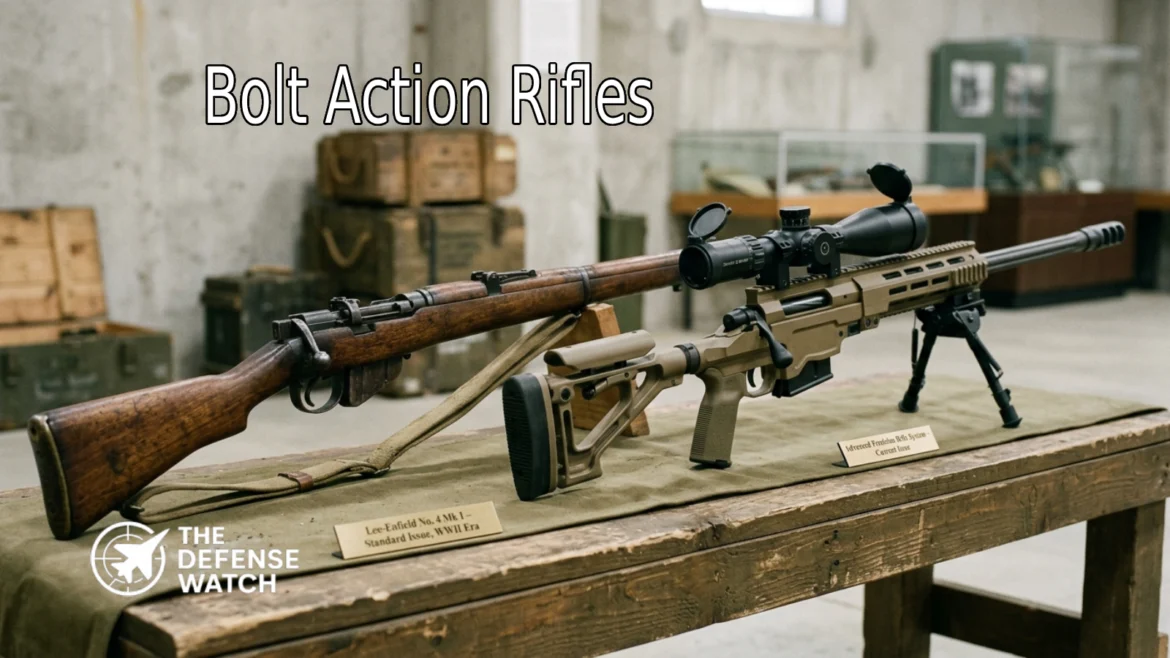
Bolt action rifles occupy an important place in the development of modern military small arms. Although most frontline infantry forces moved toward semi-automatic and select-fire rifles during the 20th century, manually operated bolt action designs remained important for precision shooting and continue to serve in modern sniper roles.
The basic operating principle is straightforward. After a shot, the shooter manually cycles a bolt to extract the spent cartridge, eject it, load a new cartridge and lock the action before the next shot. That operating cycle distinguishes bolt action rifles from self-loading designs, which use the energy generated during firing to cycle the action.
Their military importance is tied less to a single technical feature than to the combination of mechanical reliability, controlled operation and the ability to build highly consistent precision systems around a manually operated action.
From Infantry Standard to Specialized Weapon
The military rise of the bolt action rifle accelerated during the late 19th and early 20th centuries. Improvements in smokeless powder, metallic cartridges and magazine systems made repeating rifles practical for mass infantry service.
The Mauser 98 became one of the most influential examples. Mauser describes the 1898 action as a foundation for many later bolt action designs, and its basic locking arrangement influenced generations of military and sporting rifles.

Other major military rifles followed the same general operating principle. Britain fielded the Lee-Enfield family, while the United States adopted the Springfield M1903. The U.S. Army’s historical records describe the M1903 as a bolt action, magazine-fed rifle that became the standard U.S. service rifle before the transition to semi-automatic infantry weapons.
The experience of the Spanish-American War also influenced American small-arms development. U.S. Army historical material notes that the U.S. Krag-Jorgensen rifle was considered obsolete compared with the clip-loading, bolt action Mauser rifles encountered in Spanish service. The Army subsequently adopted the Springfield M1903.
Why Armies Favored the Bolt Action System
For much of the first half of the 20th century, the bolt action rifle offered a practical balance between firepower, ammunition capacity, reliability and manufacturing complexity.
A manually operated action did not require a gas system or recoil-operated mechanism to cycle the next cartridge. This simplified the operating principle and allowed military designers to concentrate on a strong locking system, durable receiver and accurate barrel.
The limitation was equally important. The shooter had to manually cycle the action after every shot. That reduced the potential rate of fire compared with later semi-automatic rifles.
The U.S. Army’s historical discussion of the Springfield M1903 illustrates this transition. The Army recognized that a semi-automatic rifle could increase the volume of fire because the weapon could eject the spent cartridge and chamber another round without requiring the shooter to manually operate the bolt.
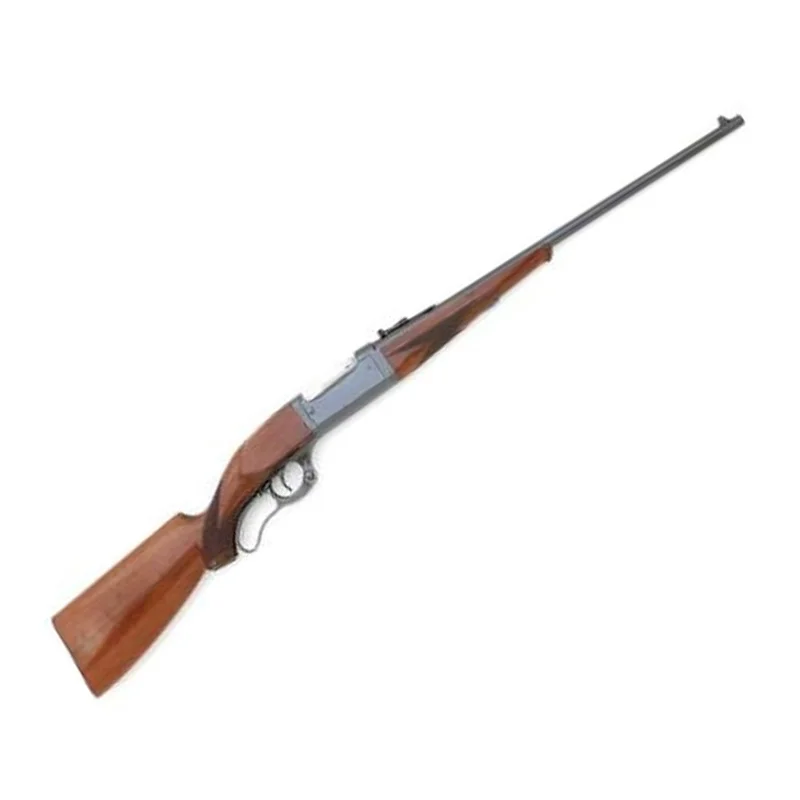
That technological shift eventually changed the role of the bolt action rifle rather than making the design completely irrelevant.
The Springfield M1903 and the First World War
The Springfield M1903 demonstrates how important bolt action rifles were to early 20th century American military doctrine.
According to the U.S. Army’s National Museum material, the M1903 was used by American Expeditionary Forces during the First World War alongside the Model 1917 rifle. Production limitations meant that the United States also relied heavily on the Model 1917 as American forces expanded.
The M1903 remained a significant U.S. military rifle for decades. Its service history also shows why bolt action rifles became closely associated with military marksmanship. A manually operated rifle could provide a stable platform for deliberate, aimed fire while remaining relatively simple to maintain compared with more mechanically complex self-loading systems.
The transition to semi-automatic rifles, however, reflected a broader change in infantry tactics. Armies increasingly valued the ability to deliver more rounds rapidly, particularly as combat became more mobile and firepower became a central part of infantry operations.
The Bolt Action Rifle Finds a New Military Role
The decline of bolt action rifles as standard infantry weapons did not eliminate them from military service.
Instead, the design became increasingly associated with specialized precision roles.
Modern military sniper rifles frequently retain a manually operated bolt action because the mission places greater emphasis on precision and controlled fire than on sustained volume of fire.
This does not mean that every modern sniper rifle is bolt action. Semi-automatic systems also have an important role, particularly where rapid follow-up shots are operationally valuable.
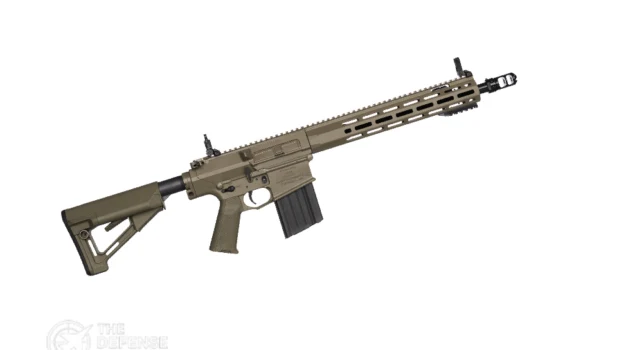
The U.S. Army’s M110 Semi-Automatic Sniper System, for example, was developed to give sniper teams greater firepower and faster engagement of multiple targets. The Army specifically contrasts the M110 with older bolt action systems such as the M24.
The continuing use of both operating systems demonstrates that the choice is driven by mission requirements rather than a simple progression in which one mechanism completely replaces another.
Modern Military Bolt Action Rifles
The U.S. Army’s MK22 Precision Sniper Rifle illustrates the continuing evolution of the bolt action concept.
The Army describes the MK22 as a multi-caliber bolt action precision sniper rifle intended for anti-personnel and anti-materiel engagements. Its modular design allows the system to use 7.62 mm, .300 and .338 caliber configurations. The Army lists an effective range of up to 1,500 meters for the system.
The Army awarded Barrett Firearms Manufacturing a five-year contract worth $49.9 million in 2021 for approximately 2,800 MK22 rifles. The procurement was part of the Precision Sniper Rifle program and included the rifle, optics and associated equipment.
The system reflects a major change from the bolt action rifles of the First World War era. Modern precision rifles can incorporate modular chassis systems, advanced optics, suppressors, specialized ammunition and interchangeable components while retaining the manually operated action.
The underlying principle has changed little. The surrounding technology has changed considerably.
Bolt Action Versus Semi-Automatic Systems
The difference between the two operating systems is primarily mechanical, but it has important operational consequences.
Attribute Bolt Action Rifle Semi-Automatic Rifle Action Manually operated Automatically cycles after firing Follow-up shots Requires manual cycling Faster follow-up capability Typical military role Precision and specialist applications Infantry and designated marksman roles Mechanical operation Relatively simple operating cycle More complex cycling mechanism Precision role Widely used Also widely used Modern military relevance Strong in specialized roles Strong across multiple combat roles These differences should not be interpreted as proof that one system is universally superior.
A sniper team operating in a precision role may value characteristics associated with a manually operated rifle, while another mission may place greater importance on rapid follow-up shots.
The U.S. Army’s continued procurement of both bolt action and semi-automatic sniper systems demonstrates that both approaches retain military utility.
Accuracy Is More Than the Action Type
It is also misleading to treat the bolt action mechanism itself as a guarantee of superior accuracy.
Precision depends on the complete weapon system and ammunition combination, as well as manufacturing quality, barrel characteristics, optics, ammunition consistency and environmental conditions.
The operating system is only one part of that equation.
Modern military precision rifles therefore combine the bolt action mechanism with specialized barrels, adjustable stocks or chassis systems, precision optics and purpose-designed ammunition. The Army’s description of the MK22 shows how modern designs integrate multiple components around the precision mission.
This is one reason contemporary bolt action rifles can look very different from the wooden-stocked military rifles of the early 20th century while retaining the same fundamental action concept.
The Industrial Legacy of the Mauser 98
The Mauser 98 is particularly important when considering the long-term influence of bolt action rifles.
Mauser identifies the 1898 action as a predecessor of modern bolt action rifles and notes that the design was produced in very large numbers and influenced numerous later systems.
Its significance extends beyond one military rifle. The action became part of the technical foundation from which later military and civilian bolt action rifles developed.
That legacy helps explain why the bolt action remains recognizable more than a century after the introduction of some of its most influential designs.
Why the Design Has Survived
The survival of bolt action rifles is not primarily a matter of tradition.
The system remains relevant because specialized military missions do not always require the maximum possible rate of fire.
A precision rifle can be designed around deliberate shot placement, optical observation and controlled engagement. The manually operated action is compatible with that approach.
Modern military requirements have also pushed bolt action systems toward modularity. The MK22, for example, was designed around multiple caliber configurations and a modular architecture intended to adapt the system to different mission requirements.
The U.S. Army has also continued research into specialized ammunition for the MK22. In 2026, Army reporting described development of the XM1224 Hybrid Anti-Materiel Round for the system, illustrating how ammunition development continues alongside the rifle itself.
What Bolt Action Rifles Mean for Modern Militaries
Bolt action rifles are no longer the default infantry rifle for major military forces, but their disappearance from general infantry formations should not be confused with obsolescence.
Their role has shifted.
During the early 20th century, the bolt action rifle was a general-purpose infantry weapon. Today, modern examples are more commonly associated with precision shooting and specialist military applications.
That change reflects the wider evolution of small arms. Semi-automatic and automatic weapons increased infantry firepower, while improved optics, ammunition, sensors and modular weapon designs created new requirements for specialized precision systems.
The modern bolt action rifle is therefore best understood as a specialized descendant of the military service rifle rather than a failed technology that survived only through tradition.
Its continued use by military forces shows that a century-old operating principle can remain relevant when the mission rewards controlled precision over maximum firing speed.