- Four RAF Typhoon fighter jets deployed from RAF Coningsby to Qatar in March 2026.
- Aircraft will integrate with the RAF Typhoon force already operating in the Gulf region.
- Deployment supports air defense operations for regional partners including Bahrain and the UAE.
- RAF personnel from the UK–Qatar joint 12 Squadron will support the mission.
- Move reinforces the UK’s commitment to regional security and collective defense cooperation.
RAF Typhoons Deploy To Qatar
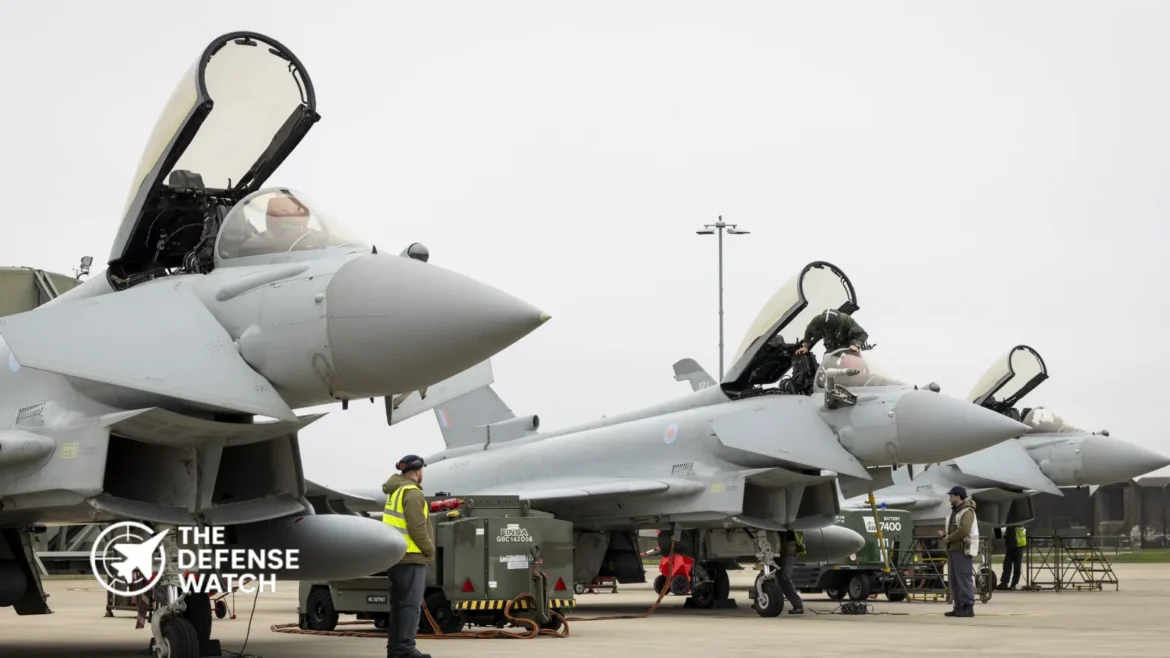
RAF Typhoons deploy to Qatar as part of the United Kingdom’s effort to strengthen its air presence in the Middle East and support regional partners facing growing security challenges. The Royal Air Force confirmed that four Typhoon fighter jets departed RAF Coningsby and arrived in Qatar to reinforce the UK’s existing air assets operating in the region.
(adsbygoogle = window.adsbygoogle || []).push({});The aircraft will integrate with RAF Typhoon units already stationed in the Gulf and operate alongside personnel from the joint UK–Qatar 12 Squadron as well as Qatar’s own Typhoon squadron.
The deployment expands the RAF’s operational capacity in the region and enhances its ability to conduct air defense missions, support coalition operations, and contribute to broader regional stability.
The Big Picture
The RAF Typhoons deploy to Qatar at a time when Middle East security dynamics are becoming increasingly complex. Western militaries have increased their operational presence across the Gulf as tensions and drone threats continue to challenge regional air defenses.
The United Kingdom has maintained a persistent military footprint in the region for decades. Air power has remained a central element of that posture, particularly through fighter deployments, intelligence sharing, and joint training programs with Gulf partners.
Deploying additional Typhoon aircraft reflects the UK’s continuing role in multinational security arrangements designed to protect shipping routes, defend allied airspace, and deter hostile actions across the Gulf region.
Qatar plays an important role in this architecture. The country hosts major coalition military infrastructure and has steadily expanded its own air capabilities through partnerships with Western defense industries.
What’s Happening
Four RAF Typhoon fighters departed RAF Coningsby in eastern England and deployed to Qatar in early March 2026.
The aircraft will join existing RAF Typhoon forces operating in the Gulf and integrate with both RAF personnel and the Qatar Emiri Air Force. The mission includes supporting regional air defense efforts for Gulf partners including Bahrain and the United Arab Emirates.
The deployment also involves personnel from 12 Squadron, a joint RAF and Qatar Emiri Air Force unit established to deepen operational cooperation between the two countries.
RAF officials say the move demonstrates the service’s ability to rapidly reinforce deployed combat air assets and respond to emerging security requirements.
The Eurofighter Typhoon remains the RAF’s primary multirole combat aircraft. It can perform air superiority, defensive counter air, and precision strike missions, making it well suited for coalition air operations and regional air policing.
Why It Matters
Forward deployment of fighter aircraft provides a rapid response capability that is critical in the Gulf region. Air defense threats in the Middle East increasingly include cruise missiles, drones, and other unmanned systems that can appear with little warning.
(adsbygoogle = window.adsbygoogle || []).push({});Typhoon aircraft equipped with advanced radar, long range air to air missiles, and precision strike weapons can help detect and intercept aerial threats before they reach critical infrastructure or population centers.
The deployment also strengthens integrated air defense cooperation among Gulf partners and Western allies.
Military planners often rely on distributed fighter forces across several regional bases. This approach improves operational resilience and reduces vulnerability to surprise attacks against a single airfield.
The presence of additional RAF Typhoons therefore increases both operational flexibility and deterrence.
Strategic Implications
The RAF Typhoons deploy to Qatar as part of a broader Western effort to maintain military stability across the Middle East.
Forward based fighter aircraft allow the United Kingdom and its allies to respond quickly to emerging threats. They also enable coalition forces to conduct air patrols, intercept suspicious aircraft or drones, and support defensive operations across the region.
The deployment reinforces Britain’s long standing defense relationship with Qatar. The two countries operate a unique joint squadron, 12 Squadron, which integrates pilots, maintainers, and operational planning personnel from both air forces.
This partnership supports Qatar’s development of its own Typhoon capability while providing the RAF with valuable operational experience working alongside Gulf air forces.
In strategic terms, these deployments help sustain a layered security architecture that includes naval forces, missile defense systems, and coalition air power across the region.
Competitor View
Regional rivals and strategic competitors closely monitor Western air deployments in the Gulf.
Countries such as Iran often interpret increases in coalition air power as part of a broader deterrence posture aimed at countering missile and drone threats. Additional fighter aircraft also complicate any potential attempt to challenge coalition air superiority in the region.
For competitors, the presence of advanced fighters like the Typhoon signals that Western forces maintain a rapid reinforcement capability and can scale up air operations quickly if the security situation deteriorates.
At the same time, Gulf partners view these deployments as reassurance that Western security commitments remain active.
Capability Gap
The RAF Typhoons deploy to Qatar partly to address the growing challenge posed by unmanned aerial threats and long range missile systems.
(adsbygoogle = window.adsbygoogle || []).push({});Small drones and loitering munitions have become common tools in regional conflicts. These systems are inexpensive but can threaten military facilities, shipping lanes, and critical energy infrastructure.
Fighter aircraft equipped with modern sensors and air to air weapons provide one layer of defense against these threats.
However, air power alone cannot eliminate the risk. Effective defense requires integrated systems that combine fighters, ground based air defense, early warning radars, and electronic warfare capabilities.
The Typhoon deployment therefore contributes to a broader defensive network rather than acting as a standalone solution.
What To Watch Next
Several developments will determine the long term impact of this deployment.
First, the RAF may adjust the size or duration of its fighter presence depending on the regional security situation. Reinforcements could include additional aircraft, support personnel, or aerial refueling assets.
Second, joint operations between RAF and Qatar Emiri Air Force units will likely expand as Qatar continues to build its Typhoon fleet and operational expertise.
Third, the deployment may feed into broader multinational air defense coordination efforts involving NATO partners and Gulf Cooperation Council states.
(adsbygoogle = window.adsbygoogle || []).push({});These trends suggest that the Gulf will remain a key theater for Western air power deployments in the coming years.
The Bottom Line
The deployment of RAF Typhoons to Qatar strengthens coalition air power in the Gulf while reinforcing the United Kingdom’s long standing defense commitments to regional security.

UK Positions Advanced Stealth Capability in Eastern Mediterranean
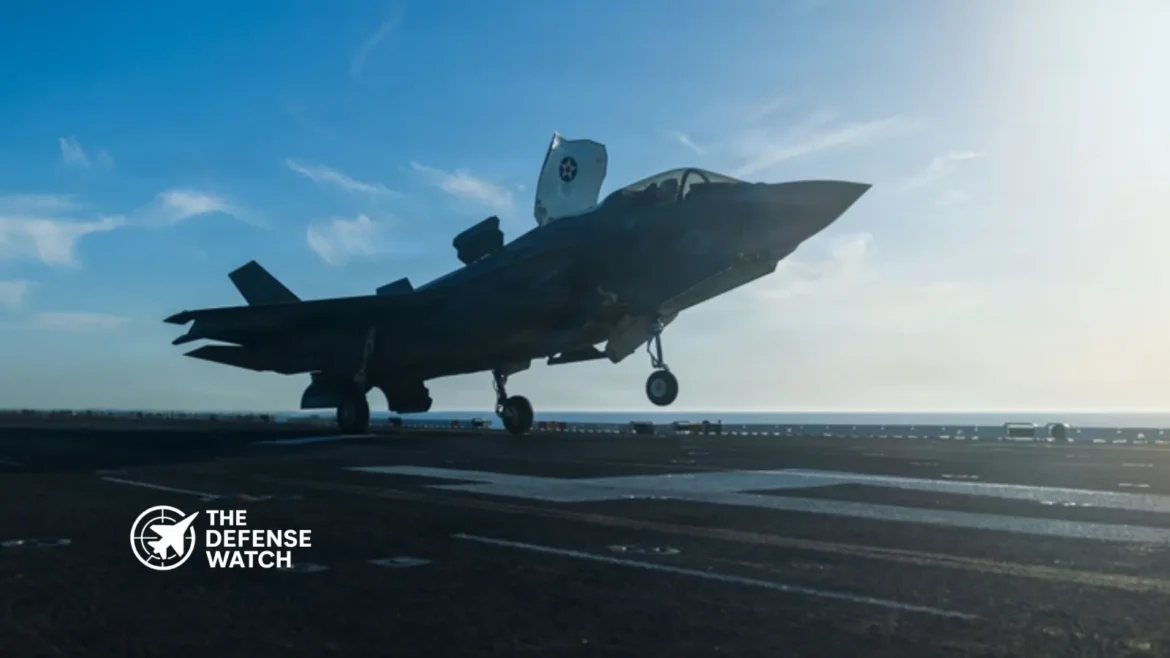
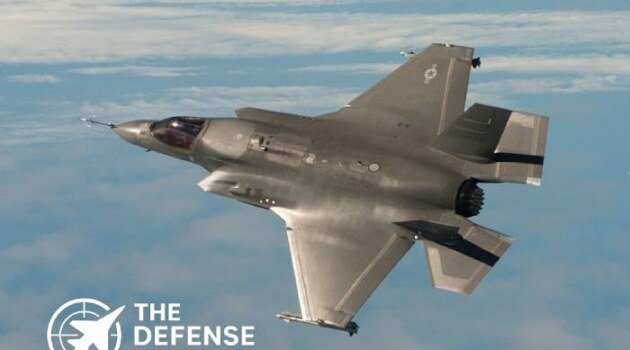
The United Kingdom has deployed six Royal Air Force F-35B Lightning II stealth fighters to RAF Akrotiri in Cyprus, significantly bolstering British military presence in the Eastern Mediterranean as regional tensions escalate following recent U.S.-Iran confrontations, according to official defense sources.The deployment of the fifth-generation stealth aircraft represents a substantial enhancement of UK military capabilities in the region, with the F-35B Lightning II fighters providing advanced reconnaissance, intelligence-gathering, and rapid-response capabilities. RAF Akrotiri, Britain’s sovereign base area on the island of Cyprus, serves as a strategic hub for operations across the Middle East and Eastern Mediterranean.
(adsbygoogle = window.adsbygoogle || []).push({});Strategic Positioning Amid Regional Instability
The UK F-35B deployment to Cyprus comes at a time of heightened security concerns across the Middle East. The timing of the deployment suggests coordination with broader Western military posturing in response to escalating tensions between the United States and Iran, though British defense officials have not explicitly linked the deployment to any specific threat scenario.
RAF Akrotiri has historically served as a critical staging point for British military operations in the region. The base’s location provides rapid access to key strategic areas across the Middle East, North Africa, and the Eastern Mediterranean. The addition of six F-35B Lightning II aircraft significantly enhances the base’s operational capabilities.
The F-35B variant is specifically designed for short takeoff and vertical landing (STOVL) operations, making it particularly suitable for deployment to forward operating bases and aircraft carriers. This capability provides the Royal Air Force with enhanced operational flexibility in austere or contested environments.
F-35B Lightning II Capabilities
The Lockheed Martin F-35B Lightning II represents the UK’s most advanced combat aircraft, combining stealth technology, advanced sensors, and network-centric warfare capabilities. Each aircraft is valued at approximately $115 million and features:
Stealth Technology: Advanced radar-absorbing materials and airframe design minimize detection by enemy air defense systems, enabling operations in contested airspace.
Sensor Fusion: Integrated sensor packages collect and process information from multiple sources, providing pilots with comprehensive situational awareness across the battlespace.
Network Integration: Data-link capabilities enable F-35B aircraft to share real-time intelligence with other platforms, including ground forces, naval vessels, and allied aircraft.
Multi-Role Capability: The aircraft can perform air-to-air combat, ground attack, reconnaissance, and electronic warfare missions using a variety of precision-guided munitions.
The UK currently operates a fleet of 48 F-35B aircraft, with plans to acquire a total of 138 aircraft over the life of the program. British F-35Bs operate from both land bases and the Royal Navy’s Queen Elizabeth-class aircraft carriers.
RAF Akrotiri’s Strategic Importance
RAF Akrotiri serves as one of the UK’s two sovereign base areas in Cyprus, established following Cypriot independence in 1960. The base occupies a critical geographic position, providing access to:
- The Eastern Mediterranean
- The Middle East theater
- North Africa
- The Black Sea region
The facility houses intelligence-gathering assets, supports aerial refueling operations, and serves as a hub for British military operations across multiple theaters. Recent infrastructure improvements have enhanced the base’s capability to support advanced combat aircraft operations.
(adsbygoogle = window.adsbygoogle || []).push({});British forces have utilized RAF Akrotiri for operations against ISIS in Iraq and Syria, humanitarian missions, and regional security operations. The base’s strategic value has increased as geopolitical tensions in the region have intensified.
Regional Security Context
The deployment occurs against a backdrop of complex security challenges across the Middle East. Recent developments include:
U.S.-Iran Relations: Ongoing tensions between Washington and Tehran have created uncertainty across the region, with concerns about potential military confrontations affecting allied planning and posture.
Maritime Security: Threats to commercial shipping in the Red Sea, Gulf of Aden, and Persian Gulf have required sustained military presence from Western nations.
Syrian Conflict: Continued instability in Syria maintains regional security concerns, with multiple international actors maintaining military presence.
Eastern Mediterranean Energy: Competing claims over natural gas resources in the Eastern Mediterranean have created additional friction points between regional actors.
British defense analysts note that the F-35B deployment enhances the UK’s ability to respond to multiple contingencies across this complex security environment.
(adsbygoogle = window.adsbygoogle || []).push({});UK Defense Posture and Capabilities
The deployment aligns with the UK’s Integrated Review of Security, Defence, Development and Foreign Policy, which emphasized a “tilt” toward the Indo-Pacific while maintaining commitments to Euro-Atlantic security and Middle Eastern stability.
Britain maintains significant military capabilities in the region through:
- Permanent facilities at RAF Akrotiri
- Naval presence in regional waters
- Special operations forces deployments
- Intelligence and surveillance assets
- Partnerships with regional allies
The F-35B deployment demonstrates the UK’s commitment to maintaining a credible military presence despite budgetary pressures and competing global priorities.
Allied Coordination and Interoperability
The UK F-35B deployment to Cyprus likely involves coordination with NATO allies and regional partners. The F-35 program is a multinational effort involving nine partner nations, with extensive interoperability built into the aircraft’s design.
British F-35B aircraft can integrate seamlessly with U.S. and other allied F-35 operations, sharing sensor data and coordinating mission planning through secure communication networks. This interoperability enhances the effectiveness of allied operations across the region.
The deployment may also involve coordination with U.S. forces operating from regional bases, including those in Qatar, Bahrain, and the United Arab Emirates. Combined operations enhance deterrence and provide flexible response options to security challenges.
Operational Considerations
Military analysts note several operational factors relevant to the F-35B deployment:
Maintenance and Logistics: Sustaining F-35B operations requires sophisticated maintenance infrastructure and supply chains. RAF Akrotiri’s existing facilities have been upgraded to support fifth-generation aircraft operations.
Pilot and Crew Readiness: RAF F-35B pilots undergo extensive training, including operations from both land bases and aircraft carriers. The Cyprus deployment provides valuable operational experience in a strategically important theater.
(adsbygoogle = window.adsbygoogle || []).push({});Mission Profiles: Potential missions could include reconnaissance, air patrols, training exercises with regional partners, and maintaining readiness for contingency operations.
Duration: Defense officials have not specified the duration of the deployment, with rotational patterns likely depending on evolving regional security requirements.
Strategic Implications
The deployment of six RAF F-35B stealth fighters to Cyprus carries several strategic implications:
Deterrence: The presence of advanced stealth aircraft enhances Western military capabilities in the region, potentially deterring adversary actions.
Reassurance: Allied nations and partners may view the deployment as evidence of sustained British commitment to regional security.
Flexibility: F-35B capabilities provide British commanders with options for responding to a range of security scenarios, from surveillance to combat operations.
Signal: The deployment sends a message about UK willingness to maintain forward military presence despite domestic political and economic challenges.
Defense experts note that stealth aircraft deployments carry particular significance due to their ability to operate in contested environments where conventional aircraft face greater risks.
Looking Ahead
The UK’s deployment of F-35B Lightning II aircraft to RAF Akrotiri represents a significant commitment of advanced military assets to the Eastern Mediterranean theater. As regional security dynamics continue to evolve, the presence of British stealth fighters provides London with enhanced options for protecting national interests and supporting allied operations.
(adsbygoogle = window.adsbygoogle || []).push({});The deployment underscores the enduring strategic importance of RAF Akrotiri and the UK’s determination to maintain a credible military presence in a region of vital global importance. Whether this deployment represents a temporary surge or the beginning of a sustained forward presence remains to be seen, with decisions likely dependent on evolving threat assessments and diplomatic developments.