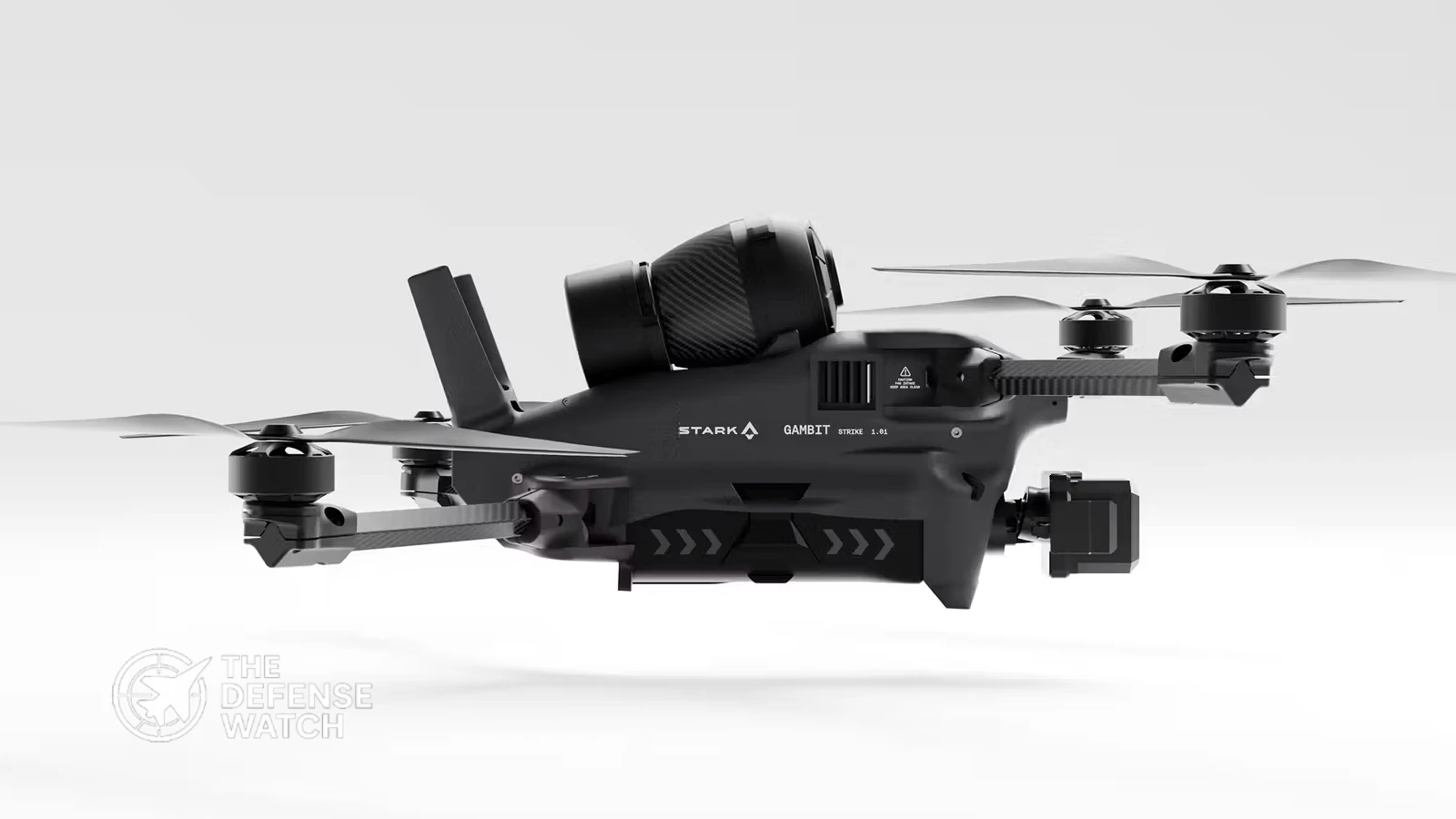
STARK Gambit Loitering Munition Clears Key Warhead Milestone
STARK’s Gambit loitering munition has moved closer to delivery after a live test in Germany demonstrated the effectiveness of its TDW-developed warhead against lightly armored targets. STARK and TDW announced the milestone on Aug. 26, saying the test satisfied a key requirement for the man-portable weapon system.
Takeaways
STARK’s Gambit loitering munition has cleared a key development milestone after a TDW warhead demonstrated the required effect against lightly armored targets in Germany.
The test involved the complete TDW effect system, including the multi-effect warhead, fuze, and safety and arming mechanism. STARK said the package was integrated into Gambit’s foldable quadcopter through an accelerated development process.
The result is significant because the warhead is not being developed in isolation from the aircraft. The demonstration validated the interaction between the payload and a small unmanned platform intended for tactical reconnaissance and precision strike missions.
TDW Warhead Demonstrates Effect Against Light Armor
TDW, an MBDA company, developed the warhead system used in the Gambit test. STARK said the warhead is fully qualified and already in service with NATO forces, although the companies have not publicly disclosed the specific NATO users or detailed performance figures for the Gambit configuration.
The companies also emphasized the safety certification work associated with the weapon. TDW Managing Director Andreas Seitz said the company did not rely on lower proof requirements that can apply to some unmanned systems, instead treating warhead, fuze and overall safety assessment as an integrated engineering problem.
That approach matters for a weapon intended to be carried by troops. A loitering munition may be smaller than a conventional missile, but it still has to meet requirements for transport, handling, arming and operation close to friendly forces.
TDW’s broader role is centered on warhead systems, including associated fuzes and safety and arming devices. MBDA identifies TDW as a specialist in warhead design and manufacture within its German operations.
What Gambit Brings to the Tactical Level
STARK introduced Gambit in June as a lightweight, foldable quadcopter intended for intelligence, surveillance and reconnaissance as well as precision effects at the forward tactical level. The company states that the system has a total weight of about 6 kilograms and can be carried and operated by one person.
STARK’s published figures provide the following baseline:
| Gambit Characteristic | Published Information |
|---|---|
| Configuration | Foldable quadcopter |
| Weight | Approximately 6 kg |
| Reconnaissance endurance | Up to 50 minutes |
| Reconnaissance operational range | Up to 40 km |
| Strike payload | Up to 2 kg |
| Strike range | Up to 25 km |
| Sensors | Electro-optical and infrared |
| Navigation | GNSS-free visual navigation |
| Communications | Jam-resistant European data link |
| Optional control | Fiber-optic control |
These figures come from STARK’s June 2026 product announcement. The company distinguishes between the reconnaissance configuration and the strike configuration, with the latter designed to carry payloads of up to 2 kilograms at ranges of up to 25 kilometers.
The combination of size, range and payload places Gambit in a different category from larger unmanned aircraft. Its intended value is not persistent surveillance over a wide area, but giving small tactical units an organic ability to locate and engage targets without relying entirely on higher-level artillery or aviation assets.
Fiber-Optic Control Addresses Electronic Warfare Risk
One of Gambit’s more relevant features for modern combat is its optional fiber-optic control architecture.
STARK says the system can be configured for fiber-optic control in contested electromagnetic environments. The company also identifies a jam-resistant European data link and GNSS-free visual navigation as elements intended to support operation when satellite navigation or conventional radio communications are degraded.
This is an important distinction in the current loitering-munition market.
Radio-controlled drones can become vulnerable when an opponent uses electronic warfare systems to interfere with command links or satellite navigation. A fiber-optic connection can reduce exposure to radio-frequency jamming along the control path, although it also introduces physical limitations associated with the fiber itself.
For a small strike system, the broader lesson is that survivability increasingly depends on communications and navigation architecture as much as on the airframe. Gambit’s design therefore reflects a wider shift toward unmanned weapons that can continue operating when the electromagnetic environment is heavily contested.
Why the Warhead Integration Matters
Integrating a qualified warhead into a small unmanned aircraft creates several engineering requirements beyond simply mounting an explosive payload to a drone.
The aircraft must safely carry the warhead during transportation and flight, while the fuze and safety and arming system must prevent unintended initiation. At the same time, the airframe has to deliver the payload to the intended target with sufficient accuracy and terminal performance.
The recent test therefore provides more information than a basic flight demonstration. It shows that STARK and TDW have moved the Gambit program through an important portion of the integration process, from separate components toward a functioning weapon system.
That distinction is important when evaluating claims about loitering-munition readiness. Flight testing can demonstrate navigation, endurance and control, but it does not by itself establish the complete weapon’s operational effectiveness.
The Gambit test addressed one of those remaining questions by demonstrating the required effect against a lightly armored target.
Germany Is Building a Broader Loitering Munition Capability
The Gambit development is taking place alongside a broader German effort to field loitering munitions.
The Bundeswehr says it signed procurement contracts with German manufacturers Helsing and STARK on Feb. 26, 2026, followed by a contract with Rheinmetall on April 22. The service says its procurement model is intended to account for the unusually rapid development cycles associated with loitering munitions.
The Bundeswehr describes loitering munitions as systems that can fly to an operating area, remain airborne while searching for targets, and then be directed against selected targets. The service highlights their ability to provide rapid and precise engagement options compared with some conventional fire-support systems.
STARK’s existing Virtus system is part of that German procurement effort. The Bundeswehr identifies Virtus as a STARK loitering munition capable of vertical takeoff before transitioning to horizontal flight toward its target.
Gambit represents a smaller tactical concept within the company’s broader unmanned portfolio.
From Virtus to Gambit
The latest test also builds on earlier cooperation between STARK and TDW.
In December 2025, the companies conducted a live firing of a TDW LION STRIKE 110 warhead integrated with STARK’s Virtus loitering munition. STARK said that demonstration was the first live firing of a loitering munition in Germany involving the companies’ system.
That earlier work established a development path for integrating German warhead technology with European unmanned systems. The Gambit test extends that work into a smaller, man-portable platform.
The two programs should not be treated as identical weapons. Virtus and Gambit occupy different roles, while the common element is the effort to integrate domestically developed effect systems with scalable unmanned platforms.
European Defense Industrial Implications
The Gambit program also illustrates a broader European defense-industrial priority: reducing the time required to turn mature components into deployable weapons.
STARK says its collaboration with TDW is based on modularity, scalability and production at scale. The companies argue that modular architectures can allow capabilities to be added more quickly while supporting larger production volumes.
For European militaries, that approach has become increasingly important as demand for expendable unmanned systems grows.
The operational challenge is not simply developing a drone that can carry a warhead. Militaries need systems that can be manufactured in meaningful quantities, transported efficiently, integrated with command-and-control networks and maintained at the tactical level.
The German procurement model reflects that reality. The Bundeswehr has explicitly acknowledged that conventional acquisition cycles can struggle to keep pace with the rapid evolution of loitering munitions.
What the Test Does Not Establish
The successful demonstration should not be interpreted as proof that Gambit has completed all stages of operational qualification.
STARK has established that the TDW warhead achieved the required effect against lightly armored targets during live testing. Publicly available information does not provide detailed figures for terminal accuracy, probability of kill, resistance to specific electronic warfare systems, production quantities or an operational delivery schedule for Gambit.
Those factors will determine how the system performs as a military capability rather than simply as a successful technology demonstration.
The published specifications also do not establish how Gambit’s performance changes under different weather conditions, electronic attack levels or target configurations. Such information would normally require additional testing and operational evaluation.
Implications for U.S. and NATO Forces
For the United States and other NATO members, the development is relevant because small loitering munitions are increasingly becoming part of the alliance’s layered approach to precision fires.
A system in the Gambit class can potentially give small units a strike option that sits between conventional small arms and larger artillery, missile or aviation assets. Its relatively small logistics footprint also supports the concept of distributing precision effects across more units and locations.
The NATO relevance is reinforced by TDW’s statement that the multi-effect warhead is already qualified and in service with NATO forces.
However, interoperability will depend on more than the warhead. Data links, command-and-control interfaces, target identification procedures, training, electronic warfare resilience and rules for employment will all influence how such systems fit into multinational formations.
The main significance of Gambit is therefore not simply its ability to carry an explosive payload. It is the combination of a man-portable airframe, precision strike capability, modular control architecture and a qualified European warhead system.
A Step Toward Delivery
The successful TDW test removes a significant technical milestone from the Gambit development path.
STARK now has a demonstrated warhead effect for a compact loitering munition that the company designed for short-range ISR and precision strike missions. The next questions concern broader qualification, production, integration and the timing of deliveries.
As Germany and other European NATO members seek greater quantities of unmanned precision weapons, systems such as Gambit are likely to be evaluated not only on individual performance but also on how quickly they can be produced, adapted and integrated into battlefield networks.
For STARK and TDW, the latest test shows that the technical integration of a qualified German warhead with a man-portable European loitering munition has reached a significant stage. For the broader European defense sector, it is another example of an effort to shorten the path from development to fieldable, scalable unmanned strike capability.