

Saab, GKN Strengthen Gripen E/F Engine Cooperation
Saab and GKN Aerospace have signed a cooperation agreement intended to expand GKN Aerospace’s role in engine and propulsion matters for the Saab Gripen E/F, as Sweden seeks to strengthen domestic expertise surrounding the fighter’s powerplant.
The agreement follows a decision by the Swedish Government to actively strengthen national capability and knowledge related to the engine used by Gripen E/F. Saab and GKN Aerospace have been tasked with establishing the conditions needed to support that objective.
For Saab, the arrangement gives GKN a progressively larger role in engine-related activities associated with the Gripen E/F program.
The two companies already cooperate on the engine used by the earlier Gripen C/D. The new agreement extends that relationship to the newer Gripen E/F generation.
From RM12 experience to RM16 support
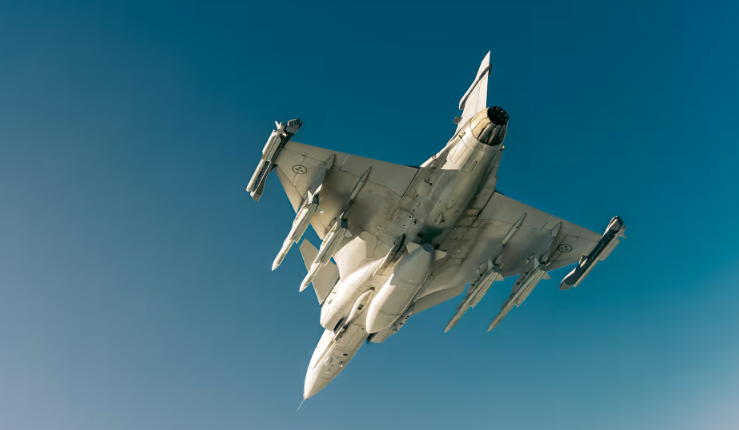
The Gripen E/F is powered by the RM16, the Swedish designation for the fighter’s version of the General Electric F414 engine. GKN Aerospace has been building Swedish capability to provide technical support and maintenance for the RM16 at its Trollhättan facility.
That work is significant because GKN’s existing role with the Gripen C/D provides an established Swedish industrial base for fighter-engine support. GKN holds the type certificate for the RM12 used by Gripen C/D and has long provided development, maintenance and technical support for that engine.
GKN’s RM16 capability has been developed in cooperation with Saab and General Electric. In 2022, GKN reported that it had completed the first RM16 engine run in its Trollhättan test facility, allowing the company to provide product support for the engine to the Swedish Armed Forces.
The new agreement therefore does not create Swedish engine expertise from scratch. Instead, it expands an existing capability and gives GKN a broader role in supporting the propulsion system of the newer fighter.
What the agreement changes
Saab said GKN Aerospace will progressively assume a greater role in engine-related matters and provide expertise, capacity and technical support for the Gripen E/F program.
Johan Segertoft, head of Saab’s Gripen business unit, said the agreement establishes GKN as Saab’s partner for engine-related matters involving Gripen E/F.
The announcement does not disclose a contract value, production quantity, specific division of responsibilities, or a timetable for the transfer of individual technical activities. Those details should therefore not be inferred from the agreement.
The arrangement is better understood as an industrial and technical cooperation framework rather than a new fighter procurement contract.
Why Sweden is strengthening the domestic engine base
Fighter aircraft depend on a small number of highly specialized industrial capabilities, and engine support is one of the areas where sustained technical knowledge can directly affect fleet availability.
Sweden has maintained domestic competence in fighter propulsion for decades. GKN Aerospace’s predecessor organizations supplied engines for earlier Swedish combat aircraft, while the company continues to support the RM12 and develop its RM16 support capability.
That industrial continuity also matters as Sweden expands its broader combat-aircraft capability.
In September, Saab received an order from the Swedish Defence Materiel Administration, FMV, for continued concept work on a future fighter system. The order is valued at approximately SEK 2.9 billion and covers work from 2026 through 2028, with options extending into 2029 and 2030.
GKN is separately involved in Swedish studies concerning future combat-air propulsion technologies. In December 2025, the company said an FMV contract extension would support studies and technology development for future engine systems and contribute to Sweden’s decision-making on combat-air capability beyond 2040.
The Gripen E/F engine cooperation therefore sits within a broader effort to preserve and develop Swedish expertise in combat aviation, rather than being an isolated maintenance initiative.
The RM16 remains an international engine program
Greater Swedish industrial involvement does not mean that the RM16 is an entirely Swedish-designed engine.
The RM16 is based on General Electric’s F414, and GKN’s support activities have been developed with continued involvement from the U.S. engine manufacturer. GKN described the RM16 in 2020 as the Swedish designation for the F414 used in Gripen E, with the underlying engine identified as the F414-GE-39E.
That distinction is important. The new cooperation strengthens Sweden’s ability to support the engine domestically, but it does not remove the international industrial relationships behind the propulsion system.
For Sweden, the practical objective is greater control over expertise, maintenance capacity and technical support within its own defense-industrial base.
A broader Gripen industrial ecosystem
The timing also comes as the Gripen E/F program expands internationally.
Saab has secured Gripen E/F orders from Thailand and Colombia, while Brazil is producing Gripen E aircraft through its industrial partnership with Saab. Saab reported in October that the first Gripen E manufactured outside Sweden completed its maiden flight in Brazil on October 6, beginning the final phase of the aircraft’s manufacturing process there.
Sweden has also taken steps toward a possible Ukrainian Gripen acquisition. Saab said in May that Ukraine intended to acquire an initial batch of up to 20 Gripen E/F aircraft, although Saab had not signed a contract or received an order at the time of that announcement.
Against that background, engine support becomes part of a wider question of how Saab and its industrial partners will sustain Gripen E/F fleets over their service lives.
For Sweden itself, the immediate issue is more specific. The government wants to preserve national expertise in a critical part of the fighter system, while Saab is positioning GKN Aerospace to take a larger role in maintaining and supporting that capability.
The agreement announced by Saab and GKN provides a framework for that cooperation. The extent of GKN’s eventual responsibilities, however, will depend on the technical arrangements and assignments that follow.