

Executive Summary:
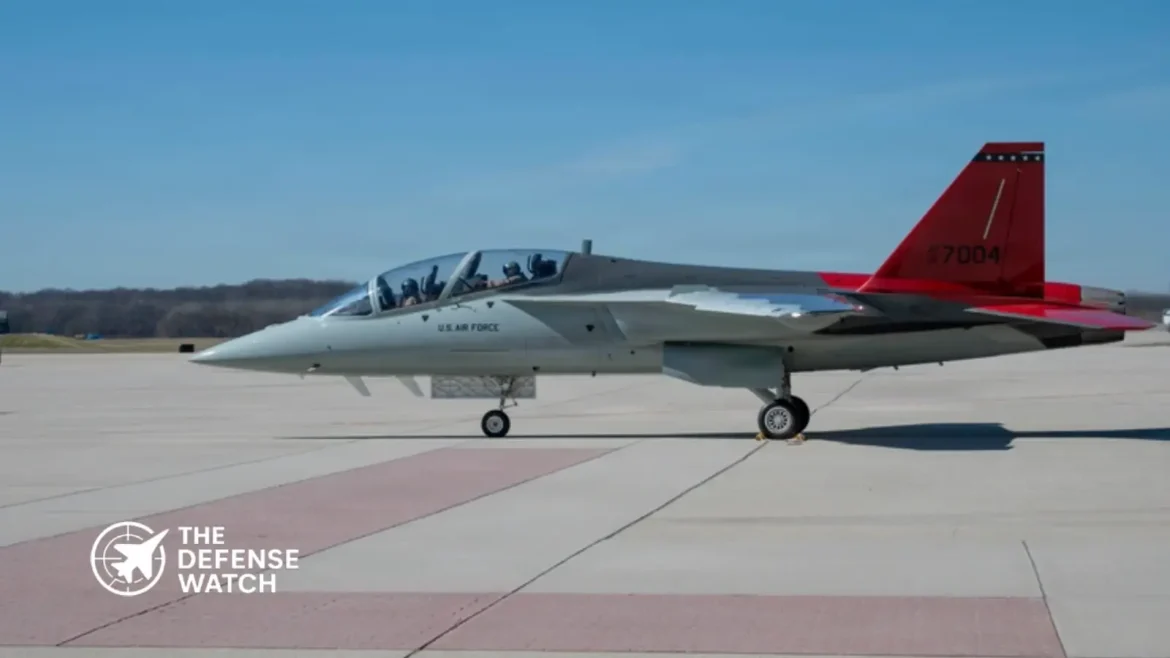
The UK Ministry of Defence has opened the procurement process for a new Royal Air Force advanced jet trainer, beginning a technical dialogue with potential suppliers on Aug. 7, 2026. The program is intended to replace the RAF’s Hawk fleet while preparing pilots for future fourth, fifth and sixth-generation combat aircraft, with the Boeing Saab T-7A Red Hawk among the aircraft positioned for the competition.
UK Opens RAF Advanced Jet Trainer Procurement
The RAF advanced jet trainer replacement program has formally entered the procurement process as the UK prepares to replace its aging Hawk fleet and update the training pipeline for future combat aircraft.
According to Defence Industry Europe, the Ministry of Defence began a technical dialogue with prospective suppliers on Aug. 7, with interested companies required to submit documentation by Sept. 11. The process could lead to a relatively rapid procurement decision as the RAF approaches the planned retirement of its Hawk aircraft.
The move follows the UK’s 2025 Strategic Defence Review, which specifically called for the Hawk T1 and Hawk T2 to be replaced with a cost-effective fast jet trainer and said the existing fast jet training arrangements needed urgent revision.
The requirement is broader than simply replacing an aircraft. The future system will have to support the training of pilots destined for increasingly sophisticated combat aircraft, while integrating modern synthetic and digital training technologies.
Hawk Replacement Becomes a Priority
The RAF currently uses the Hawk T2 as its advanced fast jet trainer. The aircraft provides two-seat training and uses advanced avionics and synthetic radar to replicate aspects of frontline combat aircraft such as the Eurofighter Typhoon.
BAE Systems describes the Hawk as a training platform capable of simulating radar, weapons and defensive systems associated with frontline fighters, helping pilots transition from training aircraft to operational fast jets.
The UK has continued to invest in Hawk support. In 2022, BAE Systems received an 11-year, £590 million contract covering support for the RAF Hawk fleet, including availability support for Hawk T2 aircraft and maintenance for the Red Arrows’ Hawk T1s.
But continued support does not eliminate the longer-term requirement for a replacement.
The older Hawk T1 aircraft used by the Red Arrows are scheduled to leave service by the end of 2030, according to the latest reporting on the procurement program. That creates a second requirement alongside conventional pilot training: the RAF must identify a future platform capable of supporting its aerobatic display team.
T-7A Red Hawk Emerges as a Major Contender
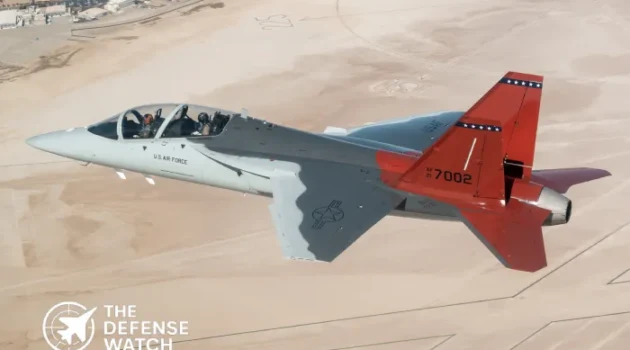
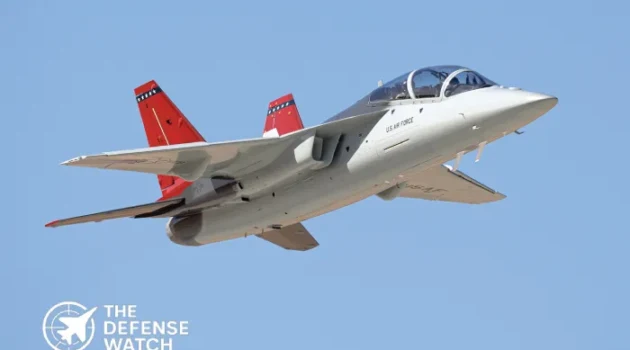
The Boeing Saab T-7A Red Hawk is one of the most significant potential candidates because it already exists as a modern advanced jet training system and has been selected by the U.S. Air Force.
In May 2026, the T-7A received U.S. Air Force Milestone C approval, clearing the program to enter low-rate initial production. Boeing’s current U.S. program calls for 351 aircraft, supported by 46 training systems and associated infrastructure under the original $9.2 billion contract awarded in 2018.
The first T-7A was formally inducted into U.S. Air Force service at Joint Base San Antonio Randolph in January 2026. The aircraft is intended to replace the T-38 Talon and train future fighter and bomber crews.
T-7A Red Hawk at a Glance
Area T-7A Red Hawk Primary role Advanced pilot training Manufacturer Boeing, with Saab as development partner U.S. customer U.S. Air Force U.S. planned fleet 351 aircraft Configuration Single engine, two-seat Cockpit Stadium seating Training architecture Live, virtual and constructive Controls Digital fly-by-wire Production status Low-rate initial production authorized UK industrial proposal Boeing, Saab and BAE Systems The T-7A’s importance to the British competition also comes from its digital architecture. Boeing describes the aircraft as a digitally designed, built and tested training system with an open architecture and integrated live, virtual and constructive training capabilities.
That approach could allow the UK to connect aircraft flying with ground-based simulation and other synthetic training environments rather than treating the trainer as a standalone aircraft.
Boeing, Saab and BAE Systems Build UK Industrial Offer
Boeing and Saab are not approaching the UK requirement alone.
BAE Systems, Boeing and Saab announced in 2025 that they would collaborate on a UK fast jet trainer proposal centered on the T-7 platform. The companies said the proposed arrangement would integrate live and synthetic training and explore expansion of the UK supply chain. BAE Systems would lead the UK activity, including a proposed UK-based final assembly capability.
The partnership is significant because UK industrial participation is an explicit consideration in the new procurement process.
The latest reporting indicates that Leonardo is another potential participant, while Korea Aerospace Industries is seeking British partners for a possible proposal. Turkish Aerospace Industries could also compete with the Hürjet advanced trainer.
This means the RAF competition is likely to assess more than aircraft performance.
The Ministry of Defence will have to consider training-system integration, delivery schedules, through-life support, industrial participation, infrastructure requirements and the ability of each candidate to fit into Britain’s broader fast jet training architecture.
Training Requirements Are Changing
The RAF’s requirement is emerging at a time when pilot training is becoming increasingly dependent on synthetic environments.
The service introduced mixed-reality technology at RAF Valley in 2026 to upgrade 11 training devices used by Hawk T2 and Texan aircraft students. The system allows trainees to practice activities such as formation flying and low-level navigation while interacting with physical cockpit equipment and virtual environments. The RAF said the program could save up to £4 million annually in training costs.
That development provides important context for the new trainer competition.
The next RAF trainer is unlikely to be evaluated only on traditional measures such as speed, handling characteristics and cockpit layout. Its ability to work within a connected training environment could be equally important.
For pilots destined for aircraft such as the F-35B, Eurofighter Typhoon and eventually next-generation combat aircraft, the training system needs to introduce increasingly complex sensor, information-management and tactical concepts before students reach operational conversion units.
The UK government’s earlier Military Flight Training System followed a similar philosophy, using multiple aircraft types and synthetic training to progressively prepare pilots for frontline aircraft.
Why the Competition Matters to U.S. Defense Strategy
The British trainer competition also has implications beyond the RAF.
The T-7A is already a U.S. Air Force program, giving Washington and London an opportunity to potentially align parts of their pilot-training architecture around a common aircraft and broader training ecosystem.
That could offer advantages in areas such as interoperability, instructor familiarity, logistics, training development and future upgrades, although any UK acquisition would still require a separate assessment of British requirements and industrial arrangements.
The T-7A’s development is also relevant because the U.S. Air Force has now moved the aircraft into low-rate initial production. That reduces one major procurement risk compared with an aircraft that remains entirely at the design or prototype stage.
At the same time, the UK would need to evaluate the aircraft independently. A platform designed primarily around U.S. Air Force requirements does not automatically satisfy RAF operational, training, industrial or support requirements.
Delivery Timing Could Shape the Competition
Schedule is one of the most important factors in the British requirement.
The RAF must maintain a credible advanced fast jet training pipeline while transitioning away from its existing Hawk fleet. The Red Arrows’ Hawk T1 retirement timetable adds another deadline to the overall requirement.
The UK’s Strategic Defence Review has already identified replacement of the Hawk T1 and T2 as a priority. The government’s Defence Investment Plan also allocates £860 million for Hawk T1 and T2 capability during fiscal years 2026-27 through 2029-30, underscoring the continuing cost of sustaining the existing fleet during the transition.
For the competing manufacturers, this makes delivery credibility a central issue.
An aircraft with strong performance characteristics but a long introduction schedule could be less attractive than a platform with an established production line and mature training infrastructure.
What Comes Next
The immediate milestone is the Sept. 11 deadline for companies interested in participating in the technical dialogue. The UK will then have to refine its requirement and determine which potential suppliers advance toward the formal competition.
The T-7A enters that process with several advantages, including U.S. Air Force selection, an established Boeing Saab industrial partnership and recent authorization for low-rate production.
Other candidates could compete on different combinations of aircraft capability, cost, industrial participation and delivery schedules.
For the RAF, however, the central objective is clear: replace the Hawk without creating a gap in advanced fast jet training and establish a training system capable of preparing pilots for a combat fleet that is moving toward increasingly connected and digitally enabled operations.
The decision will therefore shape not only which aircraft RAF instructors and students fly, but also how Britain prepares combat pilots for the next generation of air warfare.

RAF Hawk to Receive Upgraded Cockpit Software Contract
The UK Ministry of Defence has awarded a defence contract to upgrade cockpit software on Royal Air Force Hawk T1 aircraft, with delivery of the core capability expected by mid-2026, according to UK defence officials.
(adsbygoogle = window.adsbygoogle || []).push({});Under the agreement, Lincoln-based defence firm Inzpire Ltd will develop enhancements to the mission support software used by Hawk trainers, enabling Automatic Dependent Surveillance Broadcast In (ADS-B In) functionality in the aircraft support system.
Contract Details and Scope
The contract, valued at up to GBP 2.5 million (about USD 3.2 million), amends an existing single-source agreement with Inzpire, which holds intellectual property and technical rights for the Graphical Electronic Cockpit Organiser Mission Support System (GECO MSS).
The software upgrade will allow Hawk T1 mission support systems to receive real-time position data from other aircraft that broadcast ADS-B signals. That data improves situational awareness for pilots during training sorties and helps ground crews with mission planning and analysis.
ADS-B In capability is planned to be delivered no later than July 1, 2026, based on the transparency notice published by the UK Ministry of Defence on its Find a Tender service.
GECO MSS and Training Support
GECO MSS is a tablet-based software suite already in use on Hawk T1 aircraft for mission planning, execution and post-flight debriefing. Inzpire will also provide ongoing support for associated tablets, base stations and software under the contract’s terms.
(adsbygoogle = window.adsbygoogle || []).push({});The Ministry of Defence cited technical reasons for the direct award, noting that Inzpire, as the original equipment manufacturer for GECO MSS, is the only supplier capable of making the required software amendments and providing integrated support.
Hawk T1 Role and Broader Context
The BAE Systems Hawk family has served as a fast jet trainer with air arms around the world for decades. The RAF’s Hawk T1 model, in particular, has been a mainstay of pilot training, though it is gradually being replaced by newer models such as the Hawk T2 in advanced training roles.
Upgrades like the ADS-B In software reflect ongoing efforts to keep legacy trainer platforms operational and relevant, particularly as modern training demands evolve. See also: RAF explores future Hawk replacement and training solutions.
Industry Implications
While the contract is modest in value compared with full aircraft modernization programmes, it illustrates continued investment in training system capabilities and data interoperability. Upgraded situational awareness features support a safer, more networked training environment for fast jet pilots preparing to transition to advanced combat aircraft.