

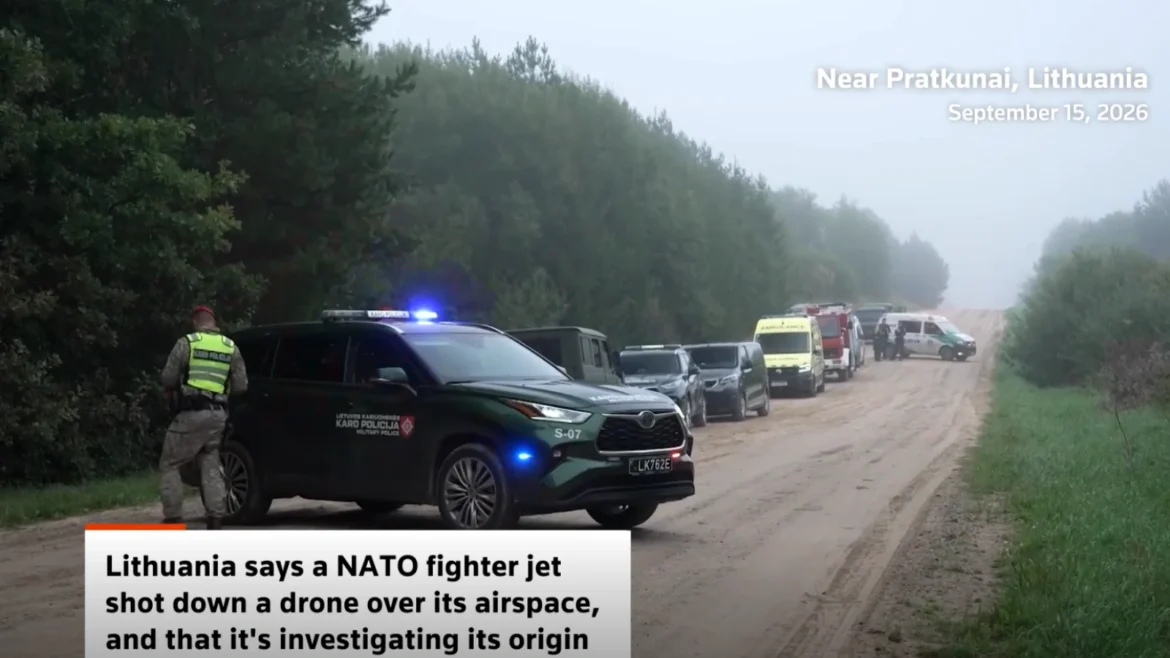
Executive Summary: An Italian NATO fighter shot down a Russian-type Gerbera drone after it entered Lithuanian airspace on September 15, 2026. Lithuanian President Gitanas Nauseda said the drone was probably intended for Ukraine but may have deviated after being affected by Ukrainian electronic warfare. Lithuanian authorities are examining the recovered drone’s electronics to establish its intended target and flight path. The incident highlights the growing challenge NATO faces from Russian unmanned aircraft operating near or unintentionally crossing Alliance airspace.
Gerbera Drone Enters Lithuanian Airspace
The Gerbera drone shot down over Lithuania was likely headed toward Ukraine before its course was altered, according to Lithuanian President Gitanas Nauseda. An Italian NATO fighter destroyed the unmanned aircraft on Tuesday after it entered Lithuanian airspace, and Lithuanian authorities are now examining its electronics to determine its targeting and navigation history.
Nauseda identified the aircraft as a Gerbera, a relatively inexpensive Russian long-range UAV used primarily as a decoy but also capable of carrying explosives. He said the available assessment indicated that the drone was probably not deliberately directed against Lithuania.
The Lithuanian president said Ukrainian electronic warfare may have affected the aircraft’s course. That remains an assessment rather than a final determination, with the Lithuanian military analyzing the recovered components.
The incident occurred near Pratkunai, with Reuters reporting that an Italian NATO fighter conducted the engagement. It represents the first suspected Russian drone shot down by the NATO Baltic Air Defence mission since Estonia, Latvia and Lithuania joined the Alliance in 2004.
Italy’s Eurofighters Provide the Intercept Capability
The aircraft involved in Lithuania’s current NATO air defense rotation are Italian Eurofighter Typhoon fighters based at Šiauliai Air Base.
Lithuania’s Ministry of National Defence said the Italian contingent began its current rotation at the end of July with four Eurofighter Typhoon aircraft. The deployment replaced French and Romanian contingents and forms part of NATO’s air defense mission over the Baltic states.
The response illustrates the role of fighter aircraft within NATO’s broader integrated air and missile defense architecture. NATO describes Air Policing as a continuous mission involving fighter aircraft, command and control, surveillance systems and other air defense assets that allow the Alliance to identify and respond to unusual or potentially hostile air activity.
The Baltic Air Policing mission has operated since 2004, when the three Baltic states joined NATO. Fighter detachments from other NATO members rotate through the region because the Baltic states rely on allied support for this particular mission.
Key Incident Details
| Item | Details |
|---|---|
| Location | Lithuania |
| Date | September 15, 2026 |
| UAV type | Gerbera |
| Reported origin | Russian-type UAV |
| Interceptor | Italian NATO fighter |
| Base | Šiauliai Air Base |
| Likely intended direction | Ukraine, according to Lithuanian president |
| Possible cause of deviation | Ukrainian electronic warfare |
| Investigation | Lithuanian military analyzing drone electronics |
| Explosive capability | Gerbera can carry explosives |
The table reflects information available from Lithuanian authorities and Reuters as of September 16, 2026.
Why the Gerbera Matters to Air Defense
The Gerbera is important not because it represents a high-end aircraft, but because relatively inexpensive unmanned systems can create difficult air defense problems when used alongside larger strike campaigns.
Russian forces have used different UAV types in the war against Ukraine, including systems designed to conduct attacks and others used to complicate Ukrainian air defense. Lithuania’s 2026 national threat assessment says increased Russian UAV operations against Ukraine have contributed to more violations of neighboring countries’ airspace. It specifically identified earlier Gerbera incidents in Lithuania and said some Russian UAVs can deviate because of technical problems or the effects of electronic warfare.
This creates an important distinction for NATO air defense planners. A drone entering Alliance airspace does not automatically establish the intent of the operator.
Instead, military forces must determine several factors quickly:
- What type of aircraft has entered the airspace?
- Where is it going?
- Does it carry an explosive payload?
- Is it responding to commands or operating autonomously?
- Has its navigation system been disrupted?
- Does the aircraft pose an immediate threat to populated areas or critical infrastructure?
Those questions can be difficult to answer in the short time available during an airspace incursion.
Electronic Warfare Adds Another Layer of Uncertainty
The Lithuanian assessment that Ukrainian electronic warfare may have contributed to the drone’s deviation illustrates one of the operational complications created by modern electronic warfare.
Electronic warfare can affect navigation, communications and other electronic functions used by unmanned aircraft. Depending on the system and circumstances, interference can contribute to navigation errors or force an aircraft to follow alternative behavior.
Lithuania’s own threat assessment has previously documented this problem. It said two Russian Gerbera UAVs that crashed in Lithuania in July 2025 entered Lithuanian airspace accidentally and linked such incidents to technical malfunctions or the effects of electronic warfare.
That history provides important context for the September 2026 incident. The presence of a Russian-type UAV inside NATO airspace does not by itself establish that Lithuania was its intended target.
The current investigation is therefore significant because the drone’s navigation and electronic components may provide evidence about its intended route.
A Broader Baltic Air Defense Challenge
The Lithuanian incident comes amid repeated drone-related airspace incidents around NATO’s eastern flank.
NATO says it expanded its air policing capabilities in response to increasing airspace violations involving Russian drones and aircraft. The Alliance also launched the Eastern Sentry activity in September 2025 to strengthen deterrence and defense along its eastern flank.
Lithuanian authorities have also reported previous Gerbera incidents. In July 2025, a Gerbera UAV crossed into Lithuanian airspace and was subsequently found crashed near Šumskas. Lithuania’s national threat assessment separately documented another Gerbera crash later that month, with the recovered aircraft carrying an explosive charge.
The recurrence of these incidents means Baltic air defense cannot rely solely on traditional identification of manned aircraft. Small UAVs create different detection and engagement requirements, particularly when they fly at low altitude and can be difficult to distinguish from other airborne objects.
Poland Reports Another Gerbera 2 Incident
The Lithuanian incident was accompanied by another development farther south.
Reuters reported that Polish prosecutors had preliminarily identified a drone found on a Baltic Sea beach as a Russian Gerbera 2. Polish authorities said the aircraft carried a warhead, which was neutralized after the drone was recovered.
The two incidents are not necessarily connected, and available reporting does not establish that they formed part of a single operation. They do, however, illustrate the geographic challenge posed by unmanned aircraft operating around the Baltic region.
For NATO, the problem extends beyond the ability to shoot down individual drones. The broader requirement is to detect, classify, track and respond to multiple types of airborne threats while maintaining enough capacity for other potential air and missile threats.
What the Incident Means for NATO Air Defense
The September 15 engagement demonstrates how NATO’s layered air defense structure can respond when an unidentified unmanned aircraft enters allied airspace.
Fighter aircraft provide a flexible interception capability, particularly when a target has to be visually identified or engaged quickly. But fighters are only one component of the wider system. NATO’s air defense architecture also includes surveillance radars, command and control networks, surface-based air defenses and ballistic missile defense capabilities.
The economic and operational balance is also important. Using a high-performance fighter to destroy a relatively inexpensive drone can be necessary when the immediate threat requires it, but repeated drone incursions create pressure to develop more scalable counter-UAS solutions.
That challenge is already being addressed across NATO. The NATO Communications and Information Agency announced a Counter-Unmanned Aircraft Systems Data Challenge in September 2026, focused on improving technologies and approaches for countering drone threats.
For the Baltic states, the practical requirement is particularly demanding. Air defense forces must protect national territory while also operating within a NATO command structure that spans multiple countries and integrates different aircraft, sensors and weapons.
Investigation Will Determine the Drone’s Intent
The most important unresolved question is the drone’s intended destination.
Nauseda said the aircraft was probably aimed at Ukraine and had been diverted from its intended route. Lithuanian military personnel are examining the drone’s electronics to determine more about its targeting and navigation.
Russia has not publicly commented on the incident, according to Reuters.
Until the Lithuanian investigation produces additional evidence, the incident should therefore be treated as a confirmed airspace violation and interception, but not as proof of an intentional Russian attack against Lithuania.
The episode nevertheless demonstrates a central problem for NATO’s eastern flank: drones launched or operating in the Russia-Ukraine war can create security risks beyond the battlefield, including accidental or unintended incursions into Alliance territory.
For NATO air defense planners, the incident reinforces the need for persistent surveillance, rapid fighter response, electronic warfare awareness and scalable counter-UAS systems capable of handling low-cost drones without relying exclusively on high-end interceptors.