

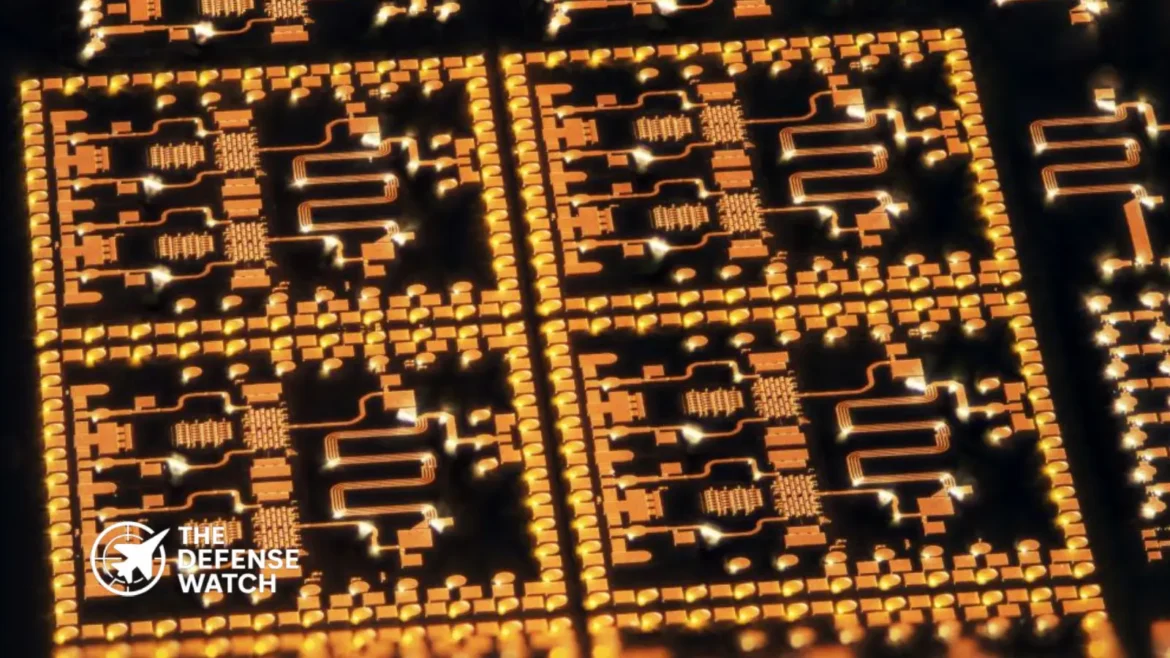
Northrop Grumman Unveils FORTITUDE RF Chip
Northrop Grumman has introduced FORTITUDE, a new name for its Super Lattice Castellated Field Effect Transistor technology, as the company moves to package more radio-frequency capability into a single gallium nitride chip.
The company announced the technology on October 2, 2026, describing FORTITUDE as a grain-of-rice-sized device designed to process large portions of the electromagnetic spectrum while reducing the number of components required in an RF system. Northrop Grumman says the technology can deliver three times more power and 20 times better signal quality, although those performance figures are company claims rather than independently verified measurements.
The underlying technology is not new. FORTITUDE is the commercial name now being applied to the SLCFET architecture that Northrop Grumman has been developing for years. The company has previously described the device as a three-dimensional gallium nitride transistor structure intended to address longstanding tradeoffs in RF switching.
From an RF switch to a system-level building block
RF switches perform a relatively simple function, routing radio-frequency signals through different paths. In a complex radar, communications, electronic warfare or sensing system, however, large numbers of RF components can introduce signal losses, consume power and add weight and physical complexity.
Northrop Grumman’s earlier technical description of SLCFET explains the problem in terms of resistance and capacitance. Conventional transistor designs face a tradeoff between the two characteristics. Lower resistance can improve signal conduction but can also increase capacitance, potentially limiting high-frequency performance. The company says its SLCFET architecture uses stacked semiconductor channels to reduce resistance without the same increase in capacitance.
The physical structure uses alternating layers of aluminum gallium nitride and gallium nitride, with a three-dimensional gate arrangement controlling the semiconductor channels. Northrop Grumman says the design can reduce insertion loss across a wide frequency range and make it possible to combine functions that would otherwise require separate RF hardware.
That distinction matters. FORTITUDE is not a replacement for a military processor or a general-purpose computing chip. Its significance lies in the RF front end, where signals are generated, routed, amplified, received and processed before reaching other parts of an electronic system.
Why gallium nitride matters
Gallium nitride, or GaN, has become increasingly important in high-frequency and high-power electronics because its material properties support applications where conventional semiconductor technologies can face limits.
Northrop Grumman already uses GaN technology across its microelectronics portfolio. Its published microelectronics data lists GaN high-electron-mobility transistor technologies and describes a U.S.-based manufacturing and packaging infrastructure supporting defense applications.
The company has also positioned its domestic microelectronics facilities as part of a broader effort to maintain control over the design, fabrication, packaging and testing of specialized defense semiconductors. Northrop Grumman says its Microelectronics Center operates semiconductor foundries in California and Maryland along with an advanced packaging facility in Florida.
For military systems, that manufacturing base can matter almost as much as raw device performance. Radar and electronic warfare systems often require specialized components that are not produced at the volumes associated with consumer electronics. Long service lives and demanding environmental requirements also create different design priorities.
What FORTITUDE could change in radar and electronic warfare
The most relevant applications identified by Northrop Grumman include radar, electronic warfare, satellites and GPS, along with future commercial communications systems. The company says FORTITUDE can replace dozens of components, potentially reducing system weight and power consumption while simplifying architecture.
For radar and electronic warfare systems, reducing the number of RF components can have several effects.
A smaller component count can reduce the physical space needed for RF hardware. Lower insertion loss can preserve more of the signal as it moves through the system. Higher power handling can provide additional design flexibility for transmit functions. And combining functions on fewer devices can reduce the number of interconnections that engineers have to manage.
Those advantages are particularly relevant as military sensors and electronic warfare systems move toward multifunction architectures. A single platform may need to operate across multiple frequency bands and perform sensing, communications, jamming or other RF missions.
Northrop Grumman has previously described SLCFET as a technology intended to support multifunction RF systems, including radar, remote sensing and directed-energy applications.
That does not mean FORTITUDE by itself gives a radar or electronic warfare system a new operational capability. The performance of a complete system still depends on antennas, amplifiers, receivers, signal processing, software, thermal management and power architecture.
The technology has moved toward production
The development history provides useful context for the latest announcement.
Northrop Grumman previously reported that SLCFET circuits had entered limited production for prototype demonstrations and that engineers were working on higher-power versions, packaging improvements and additional integration.
A paper presented through the Compound Semiconductor Manufacturing Technology conference described the maturation of the GaN-based three-dimensional transistor and reported an RF switch figure of merit greater than 1.8 THz. The same source said the manufacturing process had undergone reliability qualification for production.
The technology has also continued to generate intellectual property. A U.S. patent granted to Northrop Grumman on September 22, 2026 covers an SLCFET switch system using multiple devices arranged in a series stack for RF signal propagation. The patent identifies Northrop Grumman Systems Corporation as the assignee.
That patent does not establish how FORTITUDE will be deployed in a particular military platform. It does, however, show that the underlying RF architecture remains an active area of development.
A potential answer to the military electronics size problem
Modern defense platforms increasingly depend on electronics that must fit more capability into limited space and power budgets. Aircraft have finite electrical generation and cooling capacity. Satellites face especially strict constraints on mass, power and thermal management. Uncrewed platforms have similar pressures because additional electrical and cooling requirements can reduce the resources available for other payloads.
A technology that combines several RF functions into fewer components could therefore have value beyond its individual electrical characteristics.
The important question is how FORTITUDE performs after integration into complete systems. Northrop Grumman has disclosed headline performance comparisons, but public information does not yet establish the technology’s performance across specific operational radar, electronic warfare or satellite programs.
The company has also not publicly identified a specific operational military platform using FORTITUDE in its October 2 announcement.
That leaves the near-term significance of the technology primarily at the component and subsystem level. If the claimed power, signal-quality and integration benefits translate into production systems, the architecture could help designers reduce RF hardware while preserving or expanding functionality.
For now, FORTITUDE is best understood as the productization of a longer-running Northrop Grumman effort to improve RF switching and integration using three-dimensional GaN semiconductor structures. Its importance will ultimately depend less on the headline specifications of the chip itself than on how reliably those characteristics translate into fielded radar, electronic warfare, communications and space systems.