

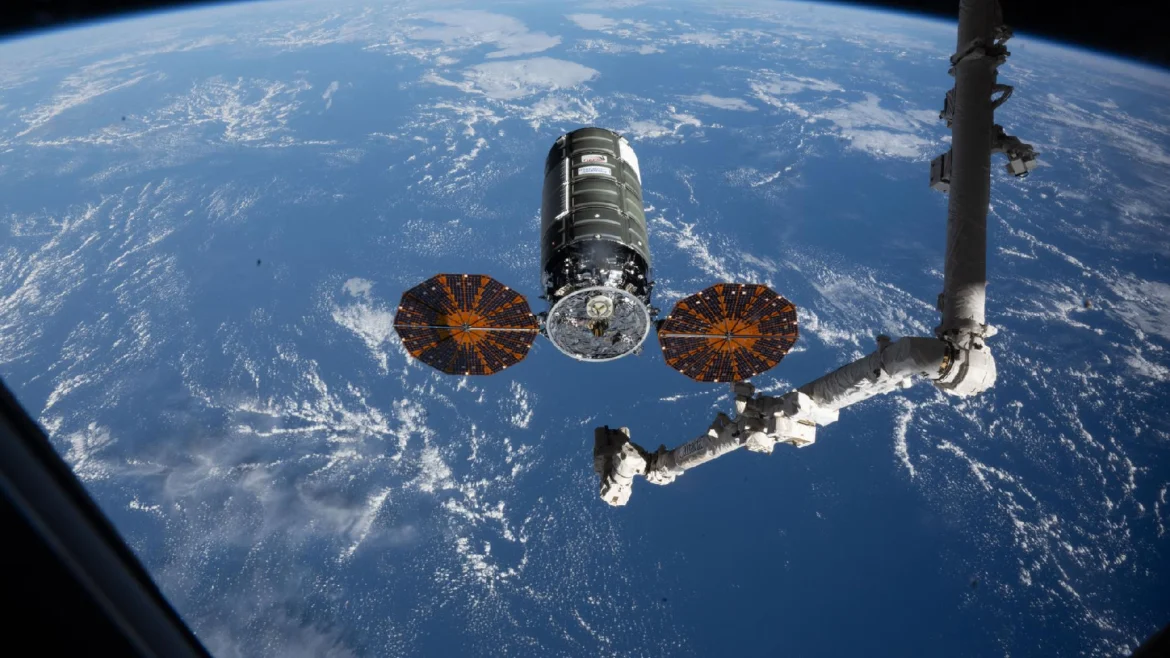
NASA Sets CRS-24 Cygnus Departure for Oct. 9
NASA is preparing to end Northrop Grumman’s CRS-24 cargo mission at the International Space Station, with the Cygnus XL spacecraft scheduled to depart the orbital complex on Oct. 9.
The spacecraft is expected to be detached from the station’s Unity module by the Canadarm2 robotic arm and released after nearly six months in orbit. NASA said live coverage of the departure will begin at 12:30 p.m. EDT, with release planned for 12:45 p.m.
The departure is the final operational phase of a resupply mission that began with a Falcon 9 launch from Space Launch Complex 40 at Cape Canaveral Space Force Station, Florida, on April 11. Cygnus XL subsequently reached the station on April 13 and was installed on Unity’s Earth-facing port.
From cargo delivery to station disposal
CRS-24 carried more than 11,000 pounds of research, supplies and other equipment to the ISS. NASA identifies the mission as the second flight of the larger Cygnus XL configuration, which provides greater cargo capacity than earlier versions of the spacecraft.
The spacecraft is named the S.S. Steven R. Nagel, honoring the former NASA astronaut who flew four Space Shuttle missions and accumulated more than 723 hours in space.
Its cargo was not limited to routine crew provisions. NASA’s mission manifest included equipment supporting station operations and experiments covering areas such as quantum science, human health, space-weather research and biological studies.
Among the research payloads was a new module for NASA’s Cold Atom Lab, which is used for quantum research in microgravity. Another investigation, InSPA-StemCellEX-H2, examines blood stem-cell production in microgravity, while Nanoracks-ITSI measures changes in radio signals as they pass through the upper atmosphere.
That radio-frequency research has an operational relevance beyond the laboratory. NASA says the measurements could improve models of solar activity and space weather, phenomena that can interfere with systems including GPS navigation and radar tracking.
The spacecraft also carried station hardware
CRS-24 also delivered hardware intended to support the station itself.
NASA’s manifest included an enhanced exercise device developed jointly with the European Space Agency, a supplemental heat-rejection system intended to provide thermal-control support in the event of failures in both existing thermal-control loops, and an ocular imaging system to replace a degraded unit in orbit.
Other cargo included hatch-seal covers, batteries for the Zarya module, water tanks, nitrogen and oxygen tanks, and a spare pretreat and water-dispenser unit. These items illustrate an important part of commercial station logistics: cargo missions are used not only to conduct research but also to maintain the infrastructure needed for long-duration human operations.
Why the departure matters
The Oct. 9 operation is more than the end of a cargo delivery. Cygnus also provides a way to remove material that is no longer required aboard the station.
NASA said the spacecraft will be loaded with thousands of pounds of disposal items and other unneeded cargo before leaving the station. The agency currently plans to deorbit Cygnus on Oct. 11, when it will undergo a destructive atmospheric reentry. NASA does not plan to provide live coverage of that phase.
This cargo-in, waste-out cycle is an important part of maintaining the ISS. A resupply spacecraft has to provide useful capacity in both directions because the station continually accumulates packaging, obsolete equipment and other material that cannot remain aboard indefinitely.
Northrop Grumman says the Cygnus design has evolved beyond its original cargo-delivery role, including increased cargo capacity, autonomous rendezvous capabilities and the ability to support station reboost operations.
For NASA, the broader significance is the continued use of commercial spacecraft as part of the agency’s logistics architecture for the ISS. NASA’s Commercial Resupply Services program relies on private U.S. companies to transport research, equipment and supplies to the station rather than operating a government-owned cargo fleet for those missions.
The CRS-24 mission also demonstrates the separation of roles within that commercial logistics chain. SpaceX provided the Falcon 9 launch vehicle, while Northrop Grumman provided the Cygnus XL spacecraft and resupply mission. Once at the station, NASA astronauts and ground controllers handled the robotic capture and installation using Canadarm2.
Departure sequence
NASA says flight controllers will command Canadarm2 to detach Cygnus XL from the Earth-facing port of the Unity module. The robotic arm will then maneuver the spacecraft into position for release.
NASA astronaut Luke Delaney is scheduled to monitor the operation from the station. After release, Cygnus will operate independently before its planned Oct. 11 deorbit.
The schedule remains subject to changes associated with real-time station operations. NASA’s published timetable currently calls for departure coverage to begin at 12:30 p.m. EDT on Oct. 9, with release targeted for 12:45 p.m.
With that operation, CRS-24 will transition from an ISS resupply mission into its final disposal phase, closing another cycle in NASA’s commercial logistics program.