

NATO Uses B-1B in Baltic Air Defense Drill
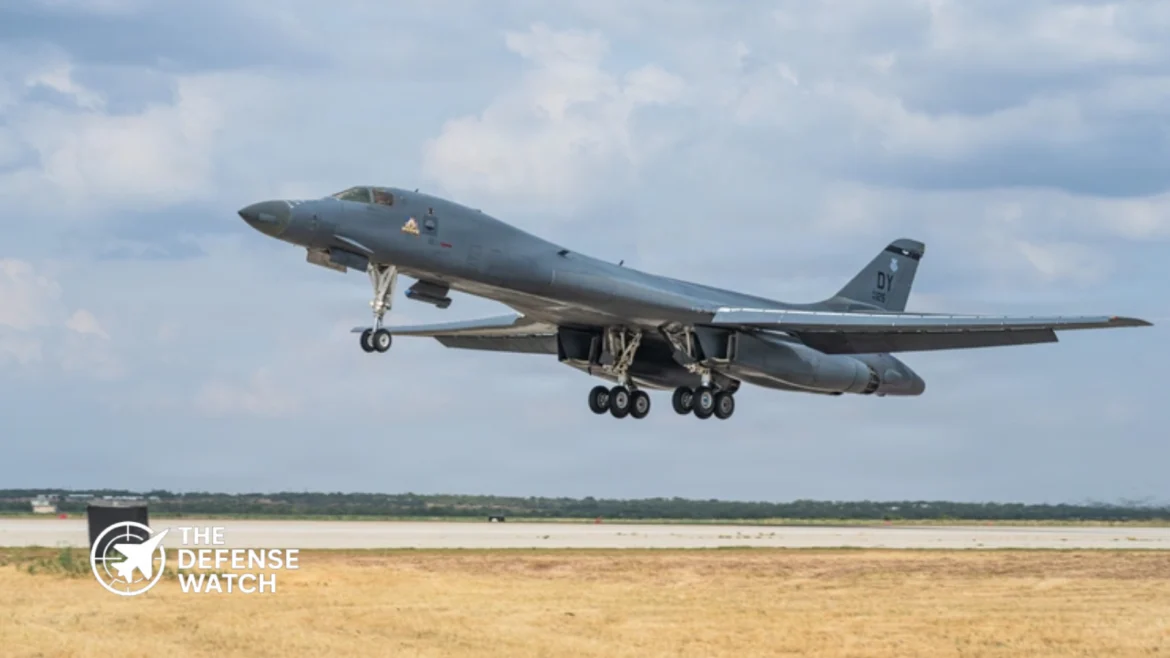
A U.S. Air Force B-1B Lancer joined a multinational NATO air defense training mission over Lithuania and Latvia on September 29, providing the alliance with a bomber participant as it tested a revised framework for integrating aircraft, tankers and ground-based assets.
The activity was organized by NATO Allied Air Command under a Flexible Deterrent Option, or FDO, and rehearsed elements of Integrated Air and Missile Defence. Germany, Italy, Latvia, Spain, Türkiye and the United States contributed forces to the exercise.
NATO said the event was the first time a U.S. bomber had participated under the alliance’s new air defense framework. The significance was less about the B-1B conducting a conventional strike mission and more about testing whether forces with different national command arrangements and operational roles can be brought together under common procedures.
From Baltic Air Policing to a broader air defense model
The exercise reflects a change in how NATO describes and organizes air defense in the Baltic region.
For years, Baltic Air Policing has centered on rotational fighter detachments deployed to protect the airspace of Estonia, Latvia and Lithuania. NATO says that mission began in 2004 after the three Baltic states joined the alliance, with fighters operating primarily from Šiauliai Air Base in Lithuania and other regional locations.
During 2026, NATO began integrating that mission into a broader Air Defence posture. The new approach is intended to combine fighter aircraft with additional air and missile defense capabilities and counter-drone systems, while using common rules, command-and-control arrangements and operational procedures.
That distinction matters because the air threat facing NATO members is no longer limited to unidentified military aircraft requiring interception. NATO’s current framework is designed to address a wider range of airborne threats, including drones, while remaining connected to the alliance’s Integrated Air and Missile Defence architecture.
What the September 29 exercise actually tested
The Baltic scenario brought together several layers of air power rather than relying on fighters alone.
German and Italian Eurofighter Typhoons, Spanish F/A-18 Hornets and Turkish F-16 Fighting Falcons operated with the B-1B. Airbus A330 Multi Role Tanker Transport aircraft from the Multinational MRTT Unit and an Italian KC-767A supported the activity with aerial refueling. Spanish and Latvian ground assets were also incorporated into the exercise.
The scenario used opposing red and blue forces. NATO assigned Joint Force Air Component responsibilities to the French Air and Space Force, with a French commander overseeing the air component. This allowed the exercise to test not only aircraft interoperability but also multinational command relationships.
That is an important distinction. The practical challenge in a multinational air defense operation is not simply putting different aircraft in the same airspace. Sensors, command centers, fighter controllers, tanker crews and ground units must operate from a common picture and respond through procedures that can function across national forces.
NATO described the FDO activity as a way to rehearse rapid force integration and refine tactics, techniques and procedures. The alliance also said the new framework gives commanders greater flexibility to integrate and direct forces provided by member states across the Supreme Allied Commander Europe area of responsibility.
Why the B-1B is useful in this type of training
The B-1B Lancer was developed as a long-range, multirole heavy bomber and is operated by the U.S. Air Force as a conventional strike platform.
According to the Air Force’s published fact sheet, the aircraft has four General Electric F101-GE-102 afterburning turbofan engines, a published maximum speed of more than 900 mph, a maximum takeoff weight of 477,000 pounds and a payload capacity of up to 75,000 pounds. The Air Force also describes its long range, speed and ability to operate in mixed force packages as important characteristics of the aircraft.
Those characteristics give the B-1B a different operational profile from the fighters participating in the Baltic mission. A fighter provides rapid interception, air combat and defensive counter-air capabilities. A bomber brings greater endurance and a substantially larger internal weapons capacity, making it a useful platform for rehearsing the integration of long-range strike aircraft into a wider air operation.
The exercise does not establish that the B-1B carried operational weapons during the mission, nor does NATO’s public description specify the bomber’s exact role within the red-versus-blue scenario. Those details should not be inferred from the aircraft’s normal capabilities.
The more useful lesson is therefore about integration. NATO was testing whether an aircraft normally associated with U.S. long-range strike operations can be incorporated into a regional air defense architecture alongside fighters, tankers and ground-based elements.
Tankers and command networks are part of the capability
The inclusion of A330 MRTT aircraft and an Italian KC-767A also illustrates a less visible requirement for sustained air operations.
Fighter aircraft can respond quickly to a developing airspace incident, but larger multinational air operations require aerial refueling, command and control, surveillance and coordination. NATO’s existing Air Policing system already relies on Combined Air Operations Centres and Quick Reaction Alert aircraft, while the broader Air Defence model expands the number and type of capabilities that can be integrated.
NATO’s airborne warning and control capability provides another example of this networked approach. The alliance operates E-3A AWACS aircraft that provide airborne surveillance, command and control and air battle management, exchanging information with ground, maritime and airborne commanders.
The September exercise did not publicly identify every sensor or command-and-control system involved. What is clear from the participating forces is that NATO is training toward an architecture in which air defense is treated as a network of capabilities rather than simply a fighter patrol.
The Baltic geography makes integration important
The Baltic region presents a particularly demanding environment for NATO air defense planning.
Estonia, Latvia and Lithuania sit close to Russia and Belarus, while Russia’s Kaliningrad exclave lies between Poland and Lithuania. NATO has consequently maintained a rotational fighter presence in the region for more than two decades, while progressively expanding the number of operating locations and opportunities for multinational training.
The introduction of a broader Air Defence posture does not eliminate the existing Air Policing mission. Instead, NATO says the rotational model continues while additional Allied capabilities can be deployed to the Baltic states.
That creates a framework in which fighter aircraft, ground-based air defense, counter-drone capabilities, airborne surveillance and long-range aircraft can potentially be coordinated according to the situation.
For NATO, repeated training is important because the technical capability of individual platforms does not automatically translate into effective multinational operations. Differences in national procedures, command authorities, communications and rules for employing force can create friction unless those issues are practiced before a crisis.
A test of integration, not a new bomber deployment
The September 29 activity should therefore be viewed as an interoperability and command-and-control exercise rather than evidence of a permanent B-1B deployment to the Baltic states.
NATO’s public reporting does not identify a permanent bomber basing arrangement resulting from the exercise, nor does it provide details of the B-1B’s originating unit or specific mission tasking during the scenario. The available information establishes the bomber’s participation, but not a permanent change to U.S. bomber posture in the Baltic region.
That distinction is important as NATO transitions from a traditional Air Policing construct toward a wider Air Defence posture. The effectiveness of the new model will depend on how well the alliance can combine forces that are normally operated by separate national organizations and employ them through a common command structure.
The B-1B’s participation provides one more test case for that problem. The aircraft itself is a mature U.S. bomber platform, but its integration into a multinational Baltic air defense scenario demonstrates the broader requirement NATO is trying to address: moving forces into a common operational framework quickly enough to respond to different types of airborne threats.
For the Baltic region, the practical measure of the new framework will ultimately be less about any single exercise and more about whether NATO can sustain a coordinated air picture, command structure and response across fighters, tankers, ground systems and other supporting capabilities when circumstances require it.