

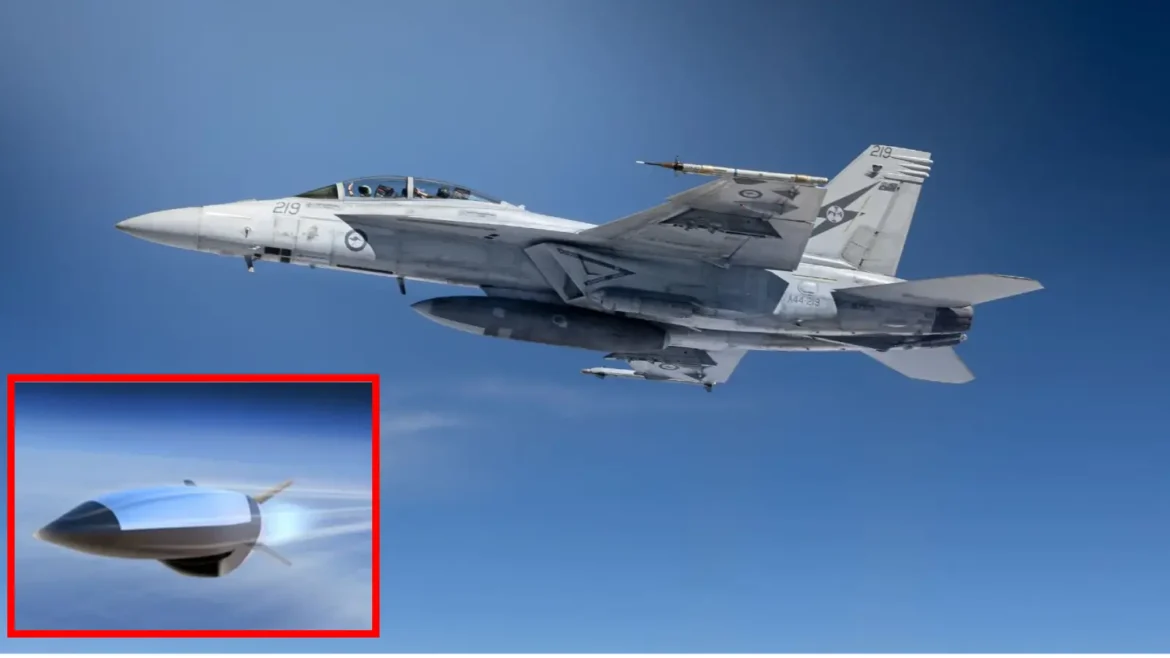
The U.S. Air Force has confirmed that the Hypersonic Attack Cruise Missile, or HACM, has entered flight testing through a U.S.-Australian test activity in Australia. The service said the Royal Australian Air Force released a HACM flight-test unit over a designated Australian test range, but it has not disclosed the location, date, launch aircraft or whether the vehicle completed powered hypersonic flight.
The confirmation provides the first official indication that HACM has moved from ground and integration work into an actual flight-test campaign. It also comes as the Air Force attempts to keep the program aligned with a planned fiscal 2027 transition toward rapid fielding.
The Air Force described the event as part of the Southern Cross Integrated Flight Research Experiment, known as SCIFiRE, a long-running U.S.-Australian effort that helped establish the technical foundation for an air-launched hypersonic cruise missile.
What the test confirms, and what it does not
The Air Force said the RAAF executed the release of a HACM flight-test unit and that the event was intended to gather data on missile performance under realistic flight conditions.
That distinction is important. The service has confirmed a flight test and release, but has not publicly said that the missile completed a full powered flight under its own propulsion. It also has not identified the Australian range used for the event.
The lack of detail prevents a firm assessment of how much of HACM’s intended flight envelope was demonstrated. A release test can provide valuable information on separation, vehicle behavior, instrumentation and other parts of the flight-test sequence without necessarily demonstrating the complete operational performance of the weapon.
Earlier U.S. government reporting identified Australia as an important location for HACM testing because of the availability of suitable hypersonic test infrastructure. A 2024 Government Accountability Office assessment said several planned HACM flight tests would occur in Australia using Royal Australian Air Force F/A-18F Super Hornets.
The expected use of Australian infrastructure therefore predates the newly confirmed test. What is new is the Air Force’s confirmation that an actual HACM flight-test event has now taken place.
A weapon built around scramjet propulsion
HACM is being developed as a conventional, air-launched hypersonic weapon for attacks against fixed, high-value and time-sensitive targets in contested environments.
Unlike a conventional cruise missile that relies on a turbine engine throughout its flight, HACM is designed around an air-breathing scramjet propulsion system. The weapon also incorporates a rocket booster to accelerate the vehicle to the conditions required for scramjet operation.
The Air Force defines HACM as a hypersonic weapon capable of sustained speeds above Mach 5. Publicly available official material does not establish a confirmed maximum speed for the operational missile, so higher figures sometimes associated with HACM should not be treated as verified specifications.
The design gives the Air Force another approach to long-range strike. Rather than relying exclusively on ballistic or boost-glide trajectories, HACM is intended to combine high speed with a maneuverable, powered flight profile.
That distinction matters for survivability. A weapon that can alter its flight path while approaching a defended target can create a more demanding engagement problem for air and missile defenses. It does not, however, make the missile immune to interception, and the effectiveness of any future operational system will depend on its complete flight profile, guidance, survivability and target-selection architecture.
Australia is more than a test location
The HACM program has roots in SCIFiRE, the U.S.-Australian effort to develop air-breathing hypersonic cruise missile technology.
The U.S. Air Force awarded Raytheon, now RTX, a contract worth nearly $985.3 million in 2022 to develop and demonstrate HACM prototypes. Northrop Grumman is responsible for the missile’s propulsion work.
The partnership builds on earlier Australian and U.S. hypersonic research rather than representing a new cooperation arrangement created specifically for the latest test.
Australia has also identified hypersonic weapons as an important part of its future long-range strike effort. Its defense planning has described HACM as a potential pathway toward an Australian air-launched hypersonic weapon and has supported integration work involving RAAF F/A-18F Super Hornets.
Australian test infrastructure has another practical advantage. Hypersonic weapons require large areas in which flight-test vehicles can be tracked and evaluated safely. The Woomera range complex has previously supported Australian and international hypersonic research, although the Air Force has not confirmed that Woomera was the location of this particular HACM event.
The program has less schedule margin than its headline suggests
The latest test is an important program milestone, but HACM is not yet an operational weapon.
The Government Accountability Office has repeatedly identified schedule pressure within the program. Its 2025 assessment said delays had reduced the planned rapid-prototyping flight-test campaign from seven tests to five.
The 2026 GAO assessment lists HACM’s rapid-prototyping effort as involving 13 missiles. Seven are test assets, four are test spares and two are intended to provide a residual operational capability.
That limited test inventory makes each flight increasingly important. The purpose of the current campaign is not simply to demonstrate that a missile can fly. Flight data must help validate the propulsion system, vehicle design, guidance and other elements needed to support a weapon that can eventually move into operational service.
The program’s schedule also leaves little room for major failures or redesigns. The Air Force’s acquisition strategy has been shaped around moving quickly from prototype development toward a rapid fielding effort.
Funding is beginning to follow the test campaign
The Air Force’s fiscal 2027 budget documentation requests $403.974 million in procurement funding for HACM. The same document shows planned procurement funding of approximately $614.3 million in fiscal 2028, $635.4 million in fiscal 2029, $680.7 million in fiscal 2030 and $693.9 million in fiscal 2031.
The documents do not disclose U.S. procurement quantities because those figures are classified as controlled unclassified information. The budget therefore should not be interpreted as a disclosed number of missiles being purchased in fiscal 2027.
The funding request is nevertheless significant because it shows the program moving beyond a purely developmental funding profile. The Air Force says initial fielding and operational use will center on the F-15E.
The broader HACM concept has also been associated with future bomber integration, but the current Air Force procurement documentation identifies the F-15E as the initial operational platform. This is another reason to distinguish current confirmed plans from longer-term platform possibilities.
Why the Australian test matters to U.S. long-range strike
For the United States, HACM is one component of a wider effort to expand conventional long-range strike options.
The Air Force already operates long-range cruise missiles and is developing additional weapons for penetrating and standoff missions. HACM is intended to add a different combination of speed, maneuverability and launch flexibility.
Its potential value is therefore not simply the ability to fly faster than a conventional cruise missile. The more important question is whether the weapon can give aircraft a credible means of attacking time-sensitive targets while reducing the exposure of the launch platform.
The Australian testing relationship also has strategic value beyond the missile itself. It gives the United States access to allied test infrastructure while deepening technical cooperation with a country that is simultaneously expanding its own long-range strike capabilities.
Australia’s 2026 defense planning continues to emphasize hypersonic technology, long-range fires and sovereign weapons development. Canberra has also said it is pursuing hypersonic capability through both SCIFiRE and the AUKUS Hypersonic Flight Test and Experimentation project.
These activities should not be treated as a single weapons program. SCIFiRE and HACM are closely connected through the U.S.-Australian hypersonic development effort, while AUKUS HyFliTE is a separate multinational test and experimentation framework. Their overlap illustrates the broader expansion of allied hypersonic research rather than evidence that one program has replaced another.
The next milestone is not simply another launch
The immediate significance of the Australian test will depend on what data the Air Force collected and whether the results support subsequent flight tests.
The service has not released enough information to determine the missile’s achieved speed, range, propulsion performance or complete flight profile during the newly confirmed event. Those details should remain open questions rather than being filled with figures from unofficial sources.
The Air Force’s stated objective remains rapid progress toward an operational HACM capability. The current flight campaign will be one of the key mechanisms for determining whether the program can maintain that schedule.
For now, the confirmed fact is narrower but important: after years of development and schedule pressure, HACM has reached an actual flight-test event in cooperation with Australia. The next evidence of progress will need to come from additional testing and the release of more performance data, not from assumptions about what the first test demonstrated.